Sri Lanka
The teardrop island south of India, ancient Ceylon, a land of tea, cinnamon and sacred cities, where Buddhism has been practised for more than two thousand years.
official capital: Sri Jayawardenepura
At a glance
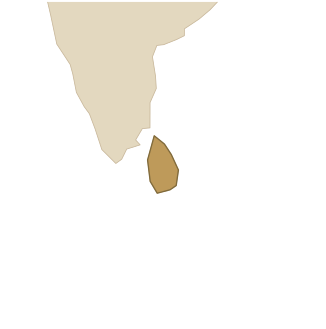
Sri Lanka, formerly Ceylon, is a large teardrop-shaped island in the Indian Ocean just off the southern tip of India, separated from it by a strait dotted with islets. This tropical land packs in rich wildlife, ancient sacred cities and more than two thousand years of history. About 22 million people live there; the main city is Colombo. Long coveted for its spices and its position on the sea routes, the island was nicknamed the "pearl of the Indian Ocean".
Geography
The island fits very different worlds into a small space. A tropical coastal plain, lined with beaches and coconut palms, runs all the way round. In the middle rise cool mountains, covered in the famous terraced tea plantations, bright green under the mist. The north and east are drier, while the southwest gets the monsoon and keeps rainforests full of wildlife: elephants, leopards and birds.
Peoples and history
The island was settled very early. According to tradition, the Sinhalese came from northern India about two and a half thousand years ago; they built great kingdoms around cities such as Anuradhapura, with huge reservoirs and giant stupas. Buddhism, brought from India in the 3rd century BCE, was carefully preserved here and became the religion of the majority. In the 5th century a king built the fortress of Sigiriya on top of a rock outcrop. Tamils from southern India also settled, from ancient times, mainly in the north. Coveted for its cinnamon, the island passed to the Portuguese, the Dutch and then the British, who brought in Tamil workers for their tea estates, before independence in 1948. A civil war then pitted the state against Tamil separatists from 1983 to 2009.
Languages and religions
The country has two main peoples and two main languages: the Sinhalese, the majority, speak Sinhala, an Indo-European language with a rounded script, and are mostly Buddhist; the Tamils, in the north, the east and the hill-country plantations, speak Tamil, a Dravidian language, and are mostly Hindu. There are also Muslims and Christians. Buddhist temples, colourful Hindu temples, mosques and churches stand side by side across the island.
Culture and way of life
Sri Lanka's big festivals, such as the Kandy procession with its decorated elephants, combine devotion and pageantry. The food, among the spiciest in the world, revolves around rice and a spread of small curries of vegetables, fish or coconut, heated with chilli and the spices the island long supplied to the world: cinnamon, cardamom and pepper. Cricket is a national passion, and the island is also known for Ayurveda, the traditional medicine, and for cutting precious stones.