Lithuania
The southernmost of the Baltic countries, a land of amber and forests, heir to a vast medieval grand duchy, where one of Europe's oldest languages is spoken.
At a glance
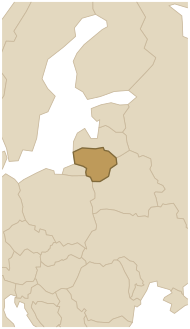
Lithuania is the largest and southernmost of the three Baltic countries, in northeastern Europe, on the Baltic Sea. Fewer than three million people live there; the capital, Vilnius, has one of the largest baroque old towns in Eastern Europe, a World Heritage site. Small today, Lithuania was once a giant: in the Middle Ages its grand duchy stretched from the Baltic to the Black Sea. A land of forests, lakes and amber, it held on to its language and identity through centuries of occupation.
Geography
Lithuania is a country of gentle plains, forests and thousands of lakes, with a cool, damp climate. Along the Baltic runs the Curonian Spit, a long strip of sand topped by shifting dunes among the highest in Europe, separating a lagoon from the sea. These shores yield amber, the "gold of the Baltic", a fossil resin collected since prehistory. Inland the country is green farmland, slow rivers and large forests that still carry the memory of the old pagan cults.
History
In the Middle Ages the Grand Duchy of Lithuania was one of the largest states in Europe, reaching from the Baltic to the Black Sea; it was also the last pagan country on the continent, holding out for a long time against the Teutonic Knights before adopting Christianity in the late 14th century. Joined with Poland in a great Commonwealth, it shared its power and later its decline, before being swallowed by the Russian Empire. Vilnius, the "Jerusalem of the North", was a great centre of Jewish life, almost entirely destroyed in the Holocaust. Independent in 1918 and later annexed by the USSR, Lithuania became in 1990 the first Soviet republic to declare independence, paving the way for the collapse of the Union.
Language and faith
Lithuanian fascinates linguists: it is one of the most archaic living languages in Europe, the one that best preserves features of the ancient Indo-European language from which Latin, Greek and Sanskrit also descend. Lithuania is deeply Catholic by tradition, a faith that was a pillar of resistance to Soviet occupation, as the Hill of Crosses shows, bristling with more than a hundred thousand crosses.
Culture and way of life
Lithuanian culture still bears the mark of its long pagan past: respect for sacred groves, oaks and household grass snakes, and the sutartinės, polyphonic songs on UNESCO's intangible heritage list. There is amber craft, carved wooden crosses and the midsummer festival at the solstice. The food is northern: cepelinai, large stuffed potato dumplings shaped like zeppelins, cold beetroot soup, black rye bread and honey.