Luxembourg
A small grand duchy in the heart of Europe, where three languages and cultures meet, a fortress town that became an EU capital and a global financial centre.
At a glance
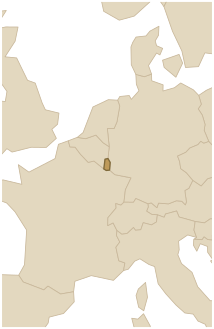
Luxembourg is one of the smallest countries in Europe, a landlocked grand duchy between Belgium, France and Germany. Yet it is one of the richest countries in the world per person, a major financial centre and one of the seats of the European Union's institutions. About 680,000 people live there, nearly half of them foreign nationals; the capital is also called Luxembourg. It is a deeply multilingual, cosmopolitan country between the Latin and Germanic worlds, attached to its motto: "we want to remain what we are".
Geography
Luxembourg has two regions. In the north is the Oesling, the foothills of the Ardennes: wooded hills, deep valleys and castles on crags, wild and green. In the south is the Gutland, the "good land", gentler and more fertile, where most towns, villages and vineyards are; here the Moselle valley, on the German border, produces well-known white wines. The capital is built on a rocky plateau ringed by the deep gorges of the Pétrusse and the Alzette, which made it one of the strongest fortresses in Europe.
History
The country grew from a castle built on a rock in 963, around which rose a powerful house that gave medieval Europe several emperors and kings. Its strategic position made the fortress of Luxembourg one of the most fought-over and heavily fortified on the continent, the "Gibraltar of the North", coveted by every great empire. After losing more than half its territory to Belgium in 1839, the grand duchy had its neutrality and independence guaranteed in 1867. Occupied in both world wars, it then committed itself to Europe and was one of the six founding members.
Languages and faith
Luxembourg has three official languages, reflecting its position at a crossroads: Luxembourgish (a Germanic language and the national language), French (the language of law and administration) and German (widely used in the press and at school). Luxembourgers switch between them every day. The country is mainly Catholic by tradition, as the capital's cathedral and devotion to Our Lady, the country's patron, show, though society today is very secular.
Culture and way of life
Luxembourg's culture is that of a small people attached to its identity in the heart of Europe, living with three languages every day and keeping its traditions while open to the world. There are popular festivals such as the dancing procession of Echternach, on UNESCO's intangible heritage list, in which pilgrims hop their way forward; the Schueberfouer, a big annual fair; and the Christmas markets. The food sits between France and Germany: judd mat gaardebounen (smoked pork collar with broad beans), the national dish, liver dumplings, pastries and Moselle wine.