Latvia
A Baltic country of forests and beaches, a land of choral singing and Art Nouveau that has kept a very old language and very old traditions.
At a glance
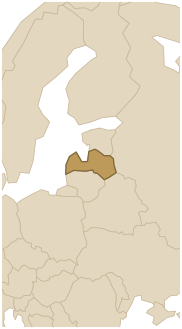
Latvia is the middle one of the three Baltic states, in northeastern Europe, on the Baltic Sea. Fewer than two million people live there, a third of them in the capital, Riga, the largest city in the Baltic states, famous for its Art Nouveau buildings and its Hanseatic old town. It is a green country of forests, rivers and long beaches, shaped by one occupation after another, which has kept through the centuries a rare language and a culture rooted in song and nature.
Geography
Latvia is a country of gentle plains, more than half covered in forest and dotted with thousands of lakes and rivers, the great Daugava among them. Along the Baltic runs a coast of white-sand beaches and dunes, as at the seaside resort of Jūrmala, and the Gulf of Riga cuts deep into the country. In the east, the hilly Latgale region is full of lakes. The four seasons are sharply marked, from bright summers to snowy winters, and the forest holds an almost sacred place in the culture.
History
Home to ancient Baltic and Finnic tribes, the region was forcibly converted and conquered in the 13th century by German crusading knights, who established a long period of German dominance; Riga became a wealthy Hanseatic city. Fought over by Swedes, Poles and Russians, Latvia was absorbed by the Russian Empire before winning its first independence in 1918. Crushed between Stalin and Hitler during the Second World War and then re-annexed by the USSR, it regained its freedom in 1991, after peaceful protests such as the "Baltic Way" of 1989, a human chain of two million people linking the three Baltic capitals.
Language and faith
Latvian is, along with Lithuanian, one of the last two living Baltic languages, a very old branch of the Indo-European family. It was at the heart of national survival through centuries of foreign rule. Latvia's Christian tradition is divided: Lutheran in the west (a German legacy), Catholic in the east and Orthodox among Russian speakers. Beneath the Christianity, the old Baltic pagan heritage survives, with its worship of nature and the cycles of the sun, very present in festivals.
Culture and way of life
Song has a special place in Latvia. The country has its dainas, hundreds of thousands of short sung poems passed down orally for centuries, about life, nature and the old gods. Every five years the great Song and Dance Festival, on UNESCO's intangible heritage list, brings together tens of thousands of singers; the independence movement of the late 1980s took from it the name "Singing Revolution". There is also amber craft, the midsummer festival (Jāņi) and northern food: black rye bread, smoked fish, beetroot and produce from the forest.