Macau
A small territory on China's south coast, the oldest European trading post in the Far East and the world's biggest gambling centre, where four centuries of Portuguese heritage meet Cantonese China.
among the densest in the world
handed back in 1999
At a glance
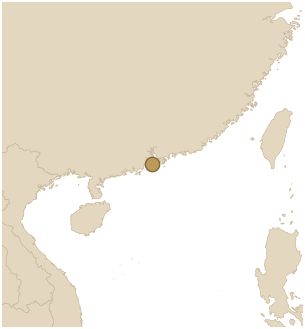
Macau is a tiny territory on the south coast of China, on the western side of the Pearl River estuary, opposite Hong Kong. A former Portuguese trading post, the oldest and longest-lasting European settlement in the Far East, held for more than four centuries, it was handed back to China in 1999 and is now a special administrative region. Nearly 700,000 people, most of them Cantonese Chinese, live on some thirty square kilometres, making it one of the most densely populated places in the world. Nicknamed the "Las Vegas of Asia", Macau has become the world's biggest gambling centre, but its lanes still show a city where China and Portugal mixed.
Geography
Macau is made up of a peninsula joined to the Chinese mainland and two former islands, Taipa and Coloane, now linked by reclaimed land: between them has risen Cotai, a strip won from the sea and covered in giant casinos. Short of space, the city is extremely dense and vertical, and keeps expanding into the estuary. The old town on the peninsula keeps its cobbled lanes, Portuguese-style squares and hills; Coloane still has a few villages, beaches and green spaces. The climate is subtropical, hot and humid.
History
A simple fishing village, Macau was granted to Portuguese merchants around 1557, who made it their base in China. It soon became a great hub of trade between China, Japan and Europe: silk, porcelain, silver and spices passed through, and the Jesuits made it a meeting place of civilisations. After centuries of splendour and then decline, overshadowed by Hong Kong, Macau stayed under Portuguese administration until its handover to China in 1999, the last European colony in Asia to change hands. Allowing casinos, which are banned elsewhere in China, it has since grown very fast to become the world's biggest gambling centre.
Language and faith
Macau's official languages are Chinese, in the Cantonese form spoken by almost everyone, and Portuguese, a colonial legacy still visible on street signs and in government but spoken by a tiny minority. Out of this meeting came patuá, a Macanese Creole that is now almost extinct. In religion, Macau mixes Chinese traditions (Buddhism, Taoism and the cult of the sea goddess A-Ma, who gave the city its name) with a Catholic heritage left by the Portuguese: baroque churches, a cathedral and the famous ruins of St Paul's. Incense-filled temples and church façades stand side by side in the same lanes.
Culture and way of life
Macanese culture mixes Cantonese China and Portugal, as the historic centre, a UNESCO World Heritage site, shows: Lisbon-style paved squares, baroque churches, Chinese temples and the ruins of St Paul's, a short walk from the neon of the giant casinos. Above all it produced Macanese cuisine, considered one of the first fusion cuisines in history, combining Chinese, Portuguese, Indian and Malay flavours: galinha à africana (African chicken), minchi, and the famous Portuguese egg tart, now eaten across Asia.