Morocco
The northwestern tip of Africa, facing Europe, a kingdom of mountains and deserts ruled by its own dynasties for more than a thousand years.
largest city: Casablanca
+ French, in everyday use
At a glance
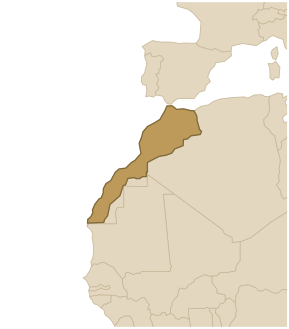
Morocco occupies the northwestern corner of Africa, where the continent comes closest to Europe: only fourteen kilometres of sea separate it from Spain. It is a country of mountains, the only one in North Africa with coastlines on both the Mediterranean and the Atlantic. About 37 million people live there, in historic imperial cities and in the great modern metropolis, Casablanca. The political capital is Rabat.
Geography
The country is crossed diagonally by the great Atlas ranges, which rise to more than four thousand metres in the High Atlas, often under snow. In the north, facing the Mediterranean, stand the Rif mountains. Between the mountains and the ocean lie fertile plains growing cereals, citrus fruit and olives. To the southeast, beyond the passes, the Sahara begins: seas of dunes, palm oases and valleys such as the Drâa. With such variety, you can go from snow to desert in a single day.
Peoples
Morocco is first of all a Berber land. The Berbers (Imazighen, "the free people") are its oldest people: the Chleuh of the south, the Riffians of the north, the Amazigh of the Middle Atlas, each with their own language and customs. From the 7th century, the arrival of the Arabs and Islam gradually Arabised much of the country, especially the cities and plains. Modern Morocco grew out of this mix, enriched by the Andalusians expelled from Spain, who left their mark on Fez and Tetouan, by the peoples of the Sahara, and by one of the oldest Jewish communities in the world, most of whose members emigrated in the 20th century, mainly to Israel.
History
Unlike the rest of North Africa, Morocco was never Ottoman and almost always kept its own dynasties. After the Berber kingdom of Mauretania and Roman rule, Islam arrived and Idris founded Fez at the end of the 8th century. Then came great Berber empires, the Almoravids and the Almohads, which at their height ruled the Maghreb and Muslim Spain, from Marrakesh to Seville. After them came the Sharifian dynasties, including the Alaouites, who have reigned since the 17th century: one of the oldest monarchies in the world. The French protectorate (1912–1956), together with a Spanish zone in the north, did not break the dynasty.
Language and religion
People in Morocco speak everyday Moroccan Arabic, darija, full of Berber and French words, and Tamazight, the Berber language, which became official in 2011. French, inherited from the protectorate, remains widely used in business and education. The country is almost entirely Muslim, following Sunni Islam of the Maliki school, with the king as "Commander of the Faithful", and deeply shaped by Sufi brotherhoods and the veneration of saints. Fez is home to the al-Qarawiyyin mosque and university, founded in 859 and often described as the oldest university still operating in the world.
Culture and way of life
Morocco is a country of crafts and flavours. Its old cities, the medinas of Fez and Marrakesh, are mazes of souks where artisans work leather, copper and zellige, mosaic of coloured glazed tile. At the table there is Friday couscous, slow-cooked tagine, sweet-and-savoury pastilla and mint tea poured from a height. In music there is gnawa, inherited from enslaved people brought from sub-Saharan Africa and on UNESCO's intangible heritage list, as well as Amazigh songs and Arab-Andalusian music.