Monaco
A tiny principality on a Mediterranean rock, home of luxury, the casino and the Grand Prix, and one of Europe's oldest states under a single dynasty.
the 2nd smallest country in the world
+ Monégasque, Italian
At a glance
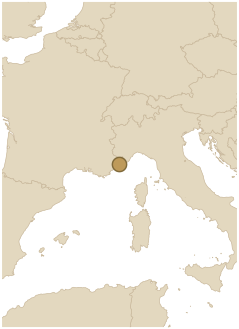
Monaco is a tiny principality on the Mediterranean, surrounded by southern France on the Riviera, about ten kilometres from Italy. It is the second-smallest country in the world after the Vatican, barely two square kilometres, and the most densely populated on the planet. About 38,000 people live there, only a quarter of them Monégasque citizens, among wealthy residents from all over the world drawn by the tax regime and the setting. Monaco is a global byword for luxury (the casino, the yacht harbour, the Grand Prix), ruled for more than seven centuries by the same dynasty, the Grimaldis; Prince Albert II has reigned since 2005.
Geography
Monaco fits entirely on a rock and a narrow strip of coast, at the foot of the Alps where they drop into the sea. Space is so short that the principality has reclaimed part of its land from the sea, most recently the Mareterra district, completed in 2024, and has built upwards. The harbour of Monte Carlo, full of large yachts, is the centre of local life. The famous Rock, a headland above the sea, holds the old town and the prince's palace. The mild, sunny Mediterranean climate and the Exotic Garden clinging to the cliff complete the scene.
History
A former Greek and then Roman trading post, the Rock entered history in 1297, when François Grimaldi took it by trickery, disguised as a monk, which is why the coat of arms shows two monks holding swords. Since then, despite many ups and downs, the Grimaldi family has almost always ruled, making Monaco one of the oldest states in Europe. In 1861 the principality gave up Menton and Roquebrune, most of its territory, to France in exchange for recognition of its independence. Long poor, it made its fortune with the Monte Carlo casino, opened in 1863, which drew Europe's aristocracy and wealth. The 1956 marriage of Prince Rainier III to the American actress Grace Kelly made the principality famous around the world.
Language and faith
The official language is French, but Monaco also has its own traditional language, Monégasque, a Ligurian dialect close to that of Genoa, now taught again in schools; Italian and English are widely used. The principality is Catholic by tradition, and Catholicism is the state religion; the cathedral on the Rock holds the tombs of the princes and of Grace Kelly. Religious festivals such as that of Saint Devota, Monaco's patron saint, remain important moments for Monégasques.
Culture and way of life
Monégasque culture combines cosmopolitan polish with stubborn local traditions. Monaco is a major venue for the arts and big events: the Opera and the Ballets de Monte-Carlo, the Oceanographic Museum and the Circus Festival. It is the world of the Formula One Grand Prix, raced through the city streets, of the casino and of the Rally. But behind the luxury, the identity and festivals of the Monégasques live on, such as Saint Devota's day, when a boat is burned in the harbour, and the traditions of the old town. The food is Mediterranean, mixing flavours from Nice and Liguria: barbagiuan, a stuffed fritter, and stocafi, a stew of dried cod.