Moldova
A small country of hills and vineyards between Romania and Ukraine, a land of wine and monasteries, little known in the east of Europe.
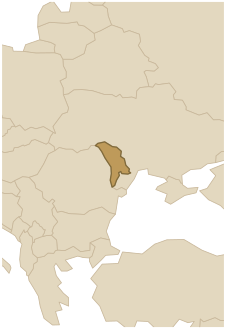
excluding Transnistria
+ Russian
At a glance
Moldova is a small, landlocked country in Eastern Europe, between Romania and Ukraine. It is one of the least known countries on the continent, long pushed about between empires. About 2.4 million people live there, not counting Transnistria; the capital is Chișinău. Moldova shares most of its language, history and culture with neighbouring Romania: they made up the old Principality of Moldavia together, and were united again between the two world wars. A land of gentle hills, orchards and above all vineyards, it is a rural country deeply tied to the vine.
Geography
Moldova is a country of hills, plains and orchards, with very fertile black soil watered by two rivers, the Dniester and the Prut. Above all it is one vast vineyard: vines grow everywhere, and the country has the largest wine cellars in the world, underground mazes tens of kilometres long at Mileștii Mici and Cricova. To the east, beyond the Dniester, lies Transnistria, a pro-Russian breakaway region whose status has been frozen since 1992. Elsewhere there are villages, monasteries among the trees and quiet countryside.
History
The Principality of Moldavia, founded in the 14th century, reached its height under Prince Stephen the Great, a national hero who held off the Ottomans and filled the country with monasteries. After it came under Ottoman overlordship, its eastern half, Bessarabia, was annexed by the Russian Empire in 1812. United with Romania between the wars, Bessarabia was seized again by Stalin in 1940 and became a Soviet republic, marked by Russification and deportations. Moldova declared independence in 1991; pulled between its Romanian heritage and Russia's orbit, it has been a candidate for European Union membership since 2022.
Language and faith
The official language is Romanian, long called "Moldovan" in Soviet times to set the country artificially apart from Romania; it is a Romance language descended from Latin, surrounded by largely Slavic neighbours. Russian is still widely spoken, a Soviet legacy. Moldova is deeply Orthodox Christian, as its many monasteries show, some cut into cliff faces like the one at Orheiul Vechi, spiritual centres and symbols of national identity.
Culture and way of life
Moldovan culture is that of a rural country attached to its traditions, very close to Romania's. Wine is at the heart of everything: many families have their own vines and cellar, and the national wine festival is the event of the year. There is the music of the lăutari, virtuoso folk musicians, the melancholy doina and circle dances, embroidery, rugs and festive costume. At the table there is mămăligă (maize polenta), cheese pastries (plăcinte), stuffed vine leaves and, of course, the house wine.