Madagascar
An island the size of a small continent in the Indian Ocean, a world apart where Africa meets Asia and where nature has produced species found nowhere else.
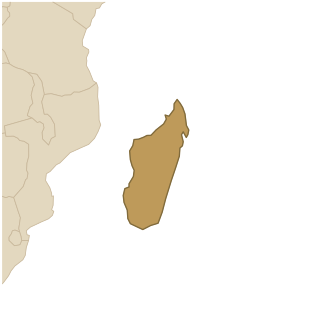
4th largest island in the world
At a glance
Madagascar is a huge island, the fourth largest in the world, lying in the Indian Ocean off the east coast of Africa, across the Mozambique Channel. Cut off for tens of millions of years, it has gone its own way, so much so that it is sometimes called the "eighth continent". About 31 million people live there; the capital, Antananarivo, sits on the central highlands. Its settlement is unusual: the Malagasy descend from both Africans and peoples from Southeast Asia.
Geography
The island is best read from east to west. A long spine of cool highlands runs down the middle, where rice grows on terraces and much of the population lives. To the east the highlands drop in a steep escarpment to a narrow strip of rainforest and the ocean. To the west they slope more gently down to dry plains and savanna. Isolated for so long, its wildlife is unique: this is the land of lemurs, baobabs and thousands of species found nowhere else.
Peoples and history
The settlement of Madagascar is one of the great puzzles of human history. Most researchers date lasting human settlement to about fifteen hundred years ago, making it one of the last large lands to be peopled. And the first settlers came from far away: Austronesian seafarers from what is now Indonesia, thousands of kilometres off, crossed the Indian Ocean to reach the island. African peoples from the nearby coast mixed with them, and later Arab traders. From this unique mix came the Malagasy and their kingdoms, among them that of the Merina of the highlands. A French colony from 1896, the island saw its 1947 uprising brutally crushed, before independence in 1960.
Language and religion
The most surprising fact is the language: Malagasy, spoken across the island, is not an African language but an Austronesian one, whose closest relative is spoken on Borneo, on the far side of the Indian Ocean. It is the living trace of that crossing. French, inherited from colonial rule, is spoken alongside it. The country is now mostly Christian, but on a very strong base of traditional belief centred on the ancestors, who watch over the living and are honoured in ceremonies such as the famadihana, the "turning of the bones".
Culture and way of life
Malagasy culture is built on respect for the ancestors and on proverbs, the ohabolana, of which the language has a great store. Rice is at the heart of everything: the Malagasy are among the biggest rice eaters in the world, and a meal without rice is not a meal. The zebu, a humped ox, is a sign of wealth and status and appears at every big occasion. Music, played on instruments such as the valiha, a bamboo zither, runs through daily life, and crafts from wild silk to marquetry are well known.