Maldives
A chain of coral atolls in the middle of the Indian Ocean, the flattest and lowest country in the world, threatened by rising seas.
+ English
At a glance
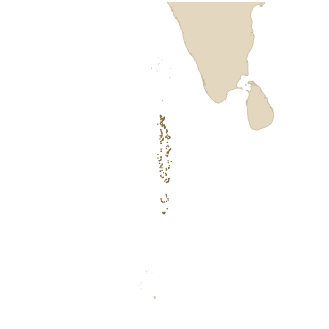
The Maldives are a long chain of coral atolls strung from north to south across the Indian Ocean, southwest of India and Sri Lanka. The country has nearly twelve hundred tiny islands, fewer than two hundred of them inhabited and more than a hundred and fifty given over to resorts. It is the flattest and lowest country in the world: its highest natural point is barely more than two metres, which leaves it badly exposed to rising seas. More than half a million people live there, mostly in the capital, Malé, one of the most densely populated cities in the world. A Muslim nation of the Indian Ocean, the Maldives are an old maritime crossroads that has become a major tourist destination.
Geography
The Maldives are made entirely of coral: rings of atolls around blue and turquoise lagoons, edged with white-sand beaches and coconut palms. Below the surface, the reefs are among the richest on the planet, full of brightly coloured fish, manta rays and whale sharks. With no high ground, an average of a metre and a half above the sea, the country is on the front line of climate change, which threatens its very existence.
History
Settled more than two thousand years ago by seafarers mainly from India and Sri Lanka, the Maldives became, thanks to their position, a major crossroads of Indian Ocean trade: they supplied the cowrie shells used as money across much of Asia and Africa. Buddhist at first, the islands converted to Islam in the 12th century. Long ruled by sultans, they became a British protectorate before gaining independence in 1965. Luxury tourism has since transformed the economy, while rising seas threaten the country's survival.
Language and faith
Maldivians speak Dhivehi, an Indo-Aryan language related to Sinhala in Sri Lanka, written in a script of its own, Thaana, which reads from right to left. English is widely used. The Maldives are an entirely Sunni Muslim country: Islam is the state religion and a condition of citizenship. The faith, which arrived with Indian Ocean trade, shapes daily life, festivals and the law.
Culture and way of life
Maldivian culture is a seafaring culture, turned towards the sea, fishing and coral. There is the dhoni, the traditional wooden boat that links the islands and is used for fishing; lacquerwork, palm-leaf weaving and calligraphy. There is bodu beru, music and dance driven by big drums, said to have come from East Africa, which livens up festivals. Life revolves around fish (tuna above all, the basis of the diet), coconut and rice.