Mexico
The land of maize, of the great Native American civilisations and, today, the most populous Spanish-speaking country.
largest Spanish-speaking country
+ 68 Indigenous languages
At a glance
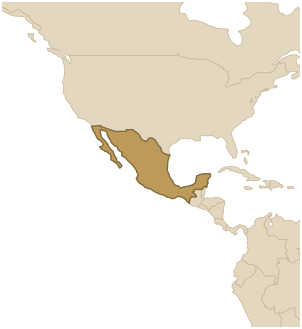
Mexico stretches between the United States to the north and Central America to the south, with the Pacific on one side and the Gulf of Mexico and the Caribbean on the other. It is a giant of about 130 million people, the most populous of all Spanish-speaking countries. Its capital, Mexico City, is one of the largest cities in the world: it stands more than two thousand metres up, on the ruins of Tenochtitlan, the old Aztec capital.
Geography
It is a country of high ground and contrasts. Two long mountain ranges, the Sierra Madre, frame a vast central plateau where most people live, overlooked by snowy volcanoes such as Popocatépetl. In the north lie deserts; in the south, rainforests and the flat Yucatán peninsula, pitted with cenotes, pools of clear water that the Maya saw as the entrance to the underworld.
Peoples and history
Long before the Europeans arrived, Mexico was home to great civilisations: the Olmecs, then the Maya (writing, astronomy, the use of zero), the great city of Teotihuacan, and finally the Mexica, the Aztecs, with their capital on a lake. From 1519, the Spanish conquest and above all the epidemics brought from Europe brought this world down: by some estimates, nearly nine in ten inhabitants died within a century. Three centuries of colonial rule followed, until independence in 1821; the country then lost half its territory to the United States in 1848, and the revolution of 1910 shaped modern Mexico. Out of this history came today's Mexican people, mostly mestizo, on an Indigenous base that is still very much alive: Nahuas, Maya, Zapotecs.
Language and religion
Spanish is spoken, but a Spanish coloured by Nahuatl: chocolate, tomato and avocado all come from the Aztecs' language. Sixty-eight Indigenous languages are still spoken. Religion is overwhelmingly Catholic, but a Catholicism mixed with older beliefs: the Virgin of Guadalupe, who according to tradition appeared in 1531 on a hill linked to an old Aztec goddess, is at its heart, and every autumn the Day of the Dead, on UNESCO's intangible heritage list, blends Indigenous veneration of ancestors with the Christian All Saints' Day.
Culture
It is a country of colour, music and strong flavours. Mariachi and ranchera are its voice; the painters Diego Rivera and Frida Kahlo gave it a face the world knows. Its cooking, on UNESCO's intangible heritage list, is an art: maize in every form, chilli, chocolate, and the slow-cooked mole sauces that combine dozens of ingredients.