North Macedonia
A small country of mountains and lakes in the heart of the Balkans, home of the great Lake Ohrid and a crossroads of peoples, with a name steeped in ancient history.
+ Albanian
At a glance
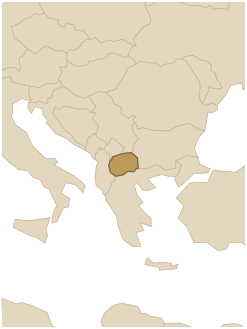
North Macedonia is a small, landlocked country in the Balkans, bordered by Greece, Bulgaria, Serbia, Kosovo and Albania. Just under two million people live there; the capital is Skopje. It is a land of mountains and lakes, home to Slavic Macedonians and a large Albanian minority. Its name, that of the ancient Macedonia of Alexander the Great, was the subject of a long dispute with neighbouring Greece, settled in 2019 by adding the word "North"; the country joined NATO the following year.
Geography
The country is almost entirely mountainous: wooded ranges and peaks surround valleys and basins, crossed by the Vardar river, which flows on into Greece. Its best-known sight is Lake Ohrid, one of the oldest and deepest lakes in Europe, with very clear water, lined with Byzantine churches and listed as World Heritage for both its nature and its culture. Nearby lies Lake Prespa. Elsewhere there are vineyards, tobacco fields, monasteries perched on hillsides and stone villages.
History
The ancient region of Macedonia gave rise to the kingdom from which Alexander the Great set out, though the heart of that kingdom lay in what is now Greece. Much later, in the 6th century, Slavs settled here. In the 9th century Ohrid became a great centre of Slavic and Orthodox civilisation, where the disciples of Cyril and Methodius spread writing and the faith. Long under Ottoman rule, Macedonia was divided in 1913 between Greece, Serbia and Bulgaria; its northern part became a republic of socialist Yugoslavia, and peacefully gained independence in 1991.
Language and faith
Macedonian is a South Slavic language close to Bulgarian, written in Cyrillic; Albanian is also an official language and widely spoken by the large Albanian minority. The country is mainly Orthodox Christian, with a national church and many Byzantine monasteries and churches, including those of Ohrid, known for their frescoes and icons. A large Muslim community, mostly Albanian and Turkish, a legacy of Ottoman rule, lives alongside the Christians.
Culture and way of life
Macedonian culture is that of a Balkan crossroads. There is music in complex rhythms, circle dances (the oro), bagpipes (gaida) and clarinets at celebrations. There are the icons and Byzantine frescoes of Ohrid, a museum town, and its pearls. There is the old Ottoman quarter of Skopje, with its bazaar and stone bridge. At the table you find ajvar, a red pepper relish, grilled meats, burek pastries, cheese and wine.