Mali
A Sahel country that, centuries ago, was one of the richest and most learned in the world.
+ 12 other official national languages · French as a working language
At a glance
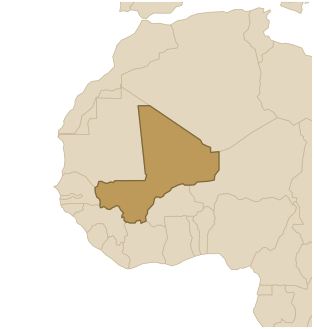
Mali is a vast landlocked country in the heart of West Africa, straddling the Sahel, the transition zone between the Sahara to the north and the savannas to the south. It is crossed by the river that gives it life, the Niger, one of Africa's great rivers, on whose banks some of the continent's richest civilisations arose. Its capital, Bamako, on the Niger, is among the fastest-growing cities in the world.
Geography
The country has two halves. In the north, two-thirds of it lies in the Sahara: stretches of sand and rock, oases and the wide open spaces of the Tuareg. In the south come the Sahel savanna and then greener land, where millet, sorghum and cotton are grown. Between the two winds the Niger, which spreads out midway into a vast inland delta, a maze of channels and rice fields. Along its great bend lie the historic towns of Djenné, Mopti and Timbuktu; further east rises the Bandiagara escarpment, the land of the Dogon.
History
Mali's history is that of three great empires of gold and learning. First came the empire of Ghana (unrelated to the modern country), then, in the 13th century, the empire of Mali, founded by Sundiata Keita, whose epic is still recited today. Its most famous ruler, Mansa Musa, made a pilgrimage to Mecca in 1324 with so much gold that he drove down its price in Egypt for years; he is often described as the richest man in history. Then came the Songhai empire, with Gao as its capital. At the heart of it all stood Timbuktu, a city of trade but above all of learning, with its schools and hundreds of thousands of manuscripts. The Moroccan invasion of 1591 and later French colonisation ended this greatness; Mali became independent in 1960. Since 2012 it has been fighting jihadist groups, and the army has ruled since the coups of 2020 and 2021.
Peoples and language
Many peoples have lived together in Mali for centuries. Its core is Mande: the Bambara (or Bamanan), the Malinke and the Soninke, direct heirs of the empire builders. Alongside them live the Fulani, semi-nomadic herders found all across the Sahel, the Songhai of the river, Bozo fishermen, the Dogon of the escarpment, famous for their cosmology, and the Tuareg of the desert. Bambara serves as a common language for almost everyone; French, inherited from colonial rule, has been only a working language since 2023.
Religion
Mali is overwhelmingly Muslim, following a Sunni Islam that came very early with the Saharan caravans, deepened in the schools of Timbuktu and often shaped by Sufi brotherhoods. Alongside it, traditional African religions survive, including that of the Dogon, one of the most studied in the world, as well as a small Christian minority. These faiths long lived side by side without conflict, until the war launched by jihadist groups in the north in 2012.
Culture
If you had to remember one thing about Mali, it would be its music: the country is one of the great musical centres of the world. Its keepers are the griots (jeli), hereditary storytellers and musicians who, since the age of the empires, have passed down from memory the history and genealogy of families. This tradition has produced artists known around the world: Salif Keita, Ali Farka Touré, Toumani Diabaté and his kora, Oumou Sangaré. Mali also means the great mosque of Djenné, the largest mud-brick building in the world, Dogon masks and mud-dyed cloth, bogolan.