Malta
A tiny archipelago in the middle of the Mediterranean, with some of the oldest temples in the world and the fortresses of the Knights, golden stone between Europe and Africa.
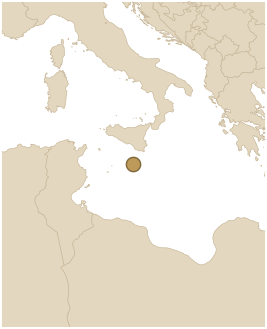
At a glance
Malta is a tiny archipelago in the middle of the Mediterranean, between Sicily and North Africa: one of the smallest countries in the world, but one of the most densely populated. More than half a million people live on its three inhabited islands, Malta, Gozo and Comino; the capital, Valletta, is a baroque city built by the Knights. Sitting in the middle of the sea, Malta was fought over and shaped by all the great peoples of the Mediterranean. A land of golden stone and blue coves, it lies where Europe meets the Arab world.
Geography
Malta is an archipelago of golden limestone, with dry, bright landscapes, almost no trees or rivers, and precious little water. Its ragged coasts are lined with cliffs, coves and inlets of intense blue, such as the Blue Lagoon on Comino, and sea caves. The islands are covered with villages dominated by big churches, dry-stone terraces and fortifications. The deep natural harbours around Valletta are among the finest in the Mediterranean and have always given the islands their strategic value. The sister island of Gozo, greener and quieter, has stayed rural.
History
Malta's megalithic temples, such as Ġgantija and Ħaġar Qim, are among the oldest free-standing stone structures in the world, older than the pyramids and Stonehenge. A Mediterranean crossroads, the island passed to the Phoenicians, Carthage and Rome (Saint Paul is said to have been shipwrecked here), then to the Arabs and the Normans. In 1530 it was handed to the Knights of the Order of Saint John, who drove off the great Ottoman siege of 1565 and built Valletta. British from the early 19th century, Malta was so heavily bombed in the Second World War that King George VI awarded the George Cross to the whole island. It became independent in 1964 and joined the European Union in 2004.
Languages and faith
Maltese is the only Semitic official language of the European Union: it grew out of the Arabic spoken on the island in the Middle Ages, is written in the Latin alphabet and has many Italian and English words. English is also official, a British legacy. Malta is one of the most deeply Catholic countries in the world: the island has hundreds of churches, many of them monumental, and the patron-saint feasts, the festi, with their processions and fireworks, are at the heart of every village's life.
Culture and way of life
Maltese culture blends the legacy of the Knights, Catholic devotion and Mediterranean ease. There is the baroque of Valletta, its palaces and its co-cathedral, which holds a masterpiece by Caravaggio. There are the village festi, silver filigree and lace, and the luzzu, brightly painted fishing boats with an eye on the prow, a custom traced back to the Phoenicians. The food sits between Italy and North Africa: fenek (rabbit), the national dish, flaky pastizzi, fish and crusty bread.