Myanmar
The land of countless golden pagodas, between India and China, a land of the great Irrawaddy river and of deeply held Buddhism.
largest city: Yangon
+ many ethnic languages
At a glance
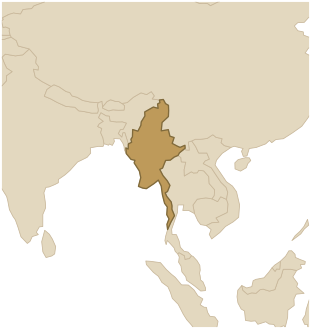
Myanmar, also known as Burma, is the largest country in mainland Southeast Asia, set between two giants, India and China, and open to the Indian Ocean in the south. Long cut off from the world, it has kept a very traditional character and an intense Buddhist faith, visible in the countless golden pagodas that dot its landscape. About 54 million people live there, most of them along the great river. The great historic city is Yangon; the capital, Naypyidaw, was built from scratch in 2005.
Geography
The whole country is built around the river that feeds it, the Irrawaddy, which runs nearly two thousand kilometres from north to south and forms a fertile central plain, the farming and human heart of Myanmar. The plain is hemmed in by a horseshoe of jungle-covered mountains, rising in the north toward the foothills of the Himalayas, home to many peoples. To the south runs a long tropical coast with beaches and islands. The climate is ruled by the monsoon, which brings heavy summer rain.
History
The Bamar people, who came from the north, founded the kingdom of Pagan in the 11th century, which unified the country and filled the plain with temples: at Bagan, more than two thousand brick shrines still stand, one of the most extraordinary sacred landscapes in the world. After several dynasties, including the powerful Konbaung, Burma was conquered by the British in the 19th century and attached to their Indian empire. Independent in 1948, it went through long decades of isolation and military rule. In 2017 more than seven hundred thousand Rohingya Muslims were driven into Bangladesh; and after a decade of democratic opening, the 2021 military coup plunged the country into civil war.
Language and faith
Burmese is a tonal language of the Sino-Tibetan family, related to Tibetan, written in a script of rounded letters that came from India. Alongside it live many languages of the hill peoples. Myanmar is one of the most deeply Buddhist countries in the world, of the Theravada branch: monks in maroon robes, alms bowls in hand, are part of everyday life, almost every boy spends some time in a monastery, and golden pagodas such as Yangon's Shwedagon are at the heart of spiritual life.
Culture and way of life
Men and women alike wear the longyi, a long wrapped skirt, and many paint their faces with thanaka, a yellow paste made from bark that serves as both make-up and sunscreen. Life follows the pagoda bells and the Buddhist festivals. People love strong, fermented flavours: tea-leaf salad, lahpet, mohinga noodle soup for breakfast and fragrant curries. Myanmar is also known for its lacquerware, woodcarving and precious stones: jade and rubies.