Montenegro
A small Balkan country of dark mountains and Adriatic coastline, home to highlanders who long held out against the empires.
At a glance
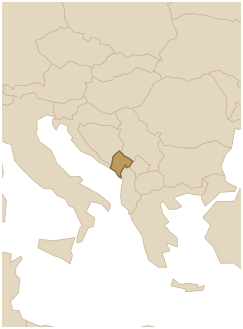
Montenegro is a small Balkan country on the Adriatic coast, whose name, "black mountain", describes it well: a land of steep, dark peaks. Just over six hundred thousand people live there; the capital is Podgorica. Proud of its history of resistance, it was one of the few parts of the Balkans never fully subdued by the Ottomans. Long joined to Serbia, it regained its independence in 2006. Small as it is, it packs in a great range of landscapes, from the Bay of Kotor to high mountain ranges.
Geography
On the coast lies the Bay of Kotor, an inlet that looks like a fjord, ringed by mountains and old Venetian towns. Right behind it rise steep mountains leading up to high ranges such as Durmitor, with its glacial lakes, and the gorge of the Tara, one of the deepest canyons in Europe. Old-growth forests, snowy peaks and Lake Skadar, a major bird reserve, complete these landscapes between sea and mountains.
History
Heir to the medieval principality of Zeta, Montenegro was known for its fierce resistance: sheltering in its mountains and ruled by prince-bishops (vladikas), it held out against the Ottoman Empire for centuries, keeping a degree of self-rule rare in the Balkans. Its independence was recognised in 1878. In the 20th century it joined Yugoslavia and remained Serbia's closest ally, forming a last joint state with it. In a 2006 referendum, Montenegrins peacefully chose independence; the country joined NATO in 2017.
Language and faith
The official language is Montenegrin, a variety of the South Slavic language shared across the region, very close to Serbian and written in both Latin and Cyrillic; many people in fact say they speak Serbian. The country is mainly Orthodox Christian, a faith central to national identity, as its perched monasteries show, such as Ostrog, clinging to a cliff face and a major place of pilgrimage. Montenegro also has Muslim (Bosniak and Albanian) minorities and, on the coast, a Catholic one.
Culture and way of life
Montenegrin culture is steeped in an ideal of honour and heroism, sung in epic poetry to the gusle, the one-stringed instrument of the mountain bards. Montenegrins are among the tallest people in Europe. On the coast life is Mediterranean, among the old stones of Kotor and Budva; inland, mountain life is harder. At the table people share njeguški (smoked ham and cheese), lamb, fish from the Adriatic and the lake, and wine.