Mongolia
The land of blue skies and endless steppe, homeland of Genghis Khan and the nomad horsemen, the last great realm of the horse and the yurt.
the least densely populated country in the world
At a glance
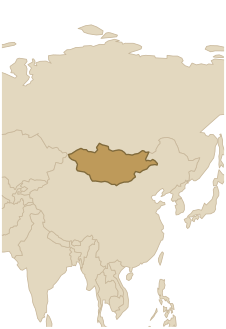
Mongolia is a vast country of steppe and desert, squeezed between Russia to the north and China to the south, with no coastline. It is the most thinly populated country on Earth: nearly three times the size of France, it has only three and a half million people, almost half of them in the capital, Ulaanbaatar. The rest of the country is open space as far as the eye can see under a brilliant blue sky (it is called the "land of the blue sky"), with a nomadic way of life that has survived better here than anywhere else.
Geography
This is the land of the steppe: vast grasslands rolling to the horizon, home to herds and horsemen. In the south they give way to the great Gobi desert, a land of stones, dunes and dinosaur fossils. To the north and west the land rises into forested mountains and high snowy peaks, extensions of Siberia and the Altai, dotted with deep blue lakes. The climate is one of the harshest in the world: scorching summers and bitterly cold winters, under an almost always clear sky.
History
In 1206 a chief brought the nomadic tribes under his rule and took the name Genghis Khan. Within a few decades, his horsemen and successors built the largest contiguous land empire in history, from Korea to Hungary and from Siberia to Persia. The empire linked East and West and made the Silk Roads safe. After that peak, Mongolia fell back into the shadow of its big neighbours (Manchu China, then the Soviet Union, whose satellite it was), before becoming a democracy in 1990.
Language and faith
Mongolian was traditionally written in a vertical script, replaced by Cyrillic in the Soviet era and now being brought back alongside it by the state. Mongolia's tradition is Tibetan Buddhist; its monasteries, almost all destroyed under communism, have been rebuilt since. Beneath the Buddhism lives a very old layer of shamanism, the religion of the steppe that worships the Eternal Sky, the spirits of nature and the ancestors: hence the ovoo, stone cairns on mountain passes that travellers walk around for a safe journey.
Culture and way of life
Mongolian culture is that of the steppe nomads, and it is still very much alive. There is the yurt (ger), a warm round felt tent that can be taken down, the family's home; and the horse, ridden from early childhood. There is throat singing, khöömii, in which one voice produces several notes at once, and golden-eagle hunting in the Altai. Every summer the great Naadam festival celebrates the "three manly games": wrestling, archery and horse racing. At the table, meat and dairy from the herd dominate.