Mozambique
A long Indian Ocean country, Portuguese-speaking, with beaches and spices, where Bantu Africa meets the Swahili world.
+ Makhuwa, Tsonga… (Bantu)
At a glance
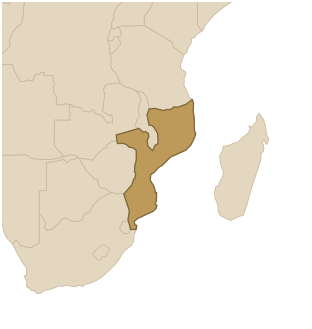
Mozambique stretches along Africa's southeast coast, facing the Indian Ocean, with nearly two and a half thousand kilometres of shoreline. It is Africa's second Portuguese-speaking country after Angola, a legacy of five centuries of Portuguese presence. With its turquoise water and its archipelagos, it has some of the finest beaches on the continent. About 34 million people live there; the capital, Maputo, is in the far south. The country has long looked to the sea, a great crossroads of trade between Africa, Arabia and Asia.
Geography
Most of the country is low, hot, tropical coastal plain, wide in the south and narrow in the north, backed by plateaus and a few mountains further inland. The great Zambezi crosses it, splitting it in two, before reaching the Indian Ocean. The coast, lined with mangroves, coral reefs and archipelagos such as Bazaruto, is very rich in marine life. The tropical climate follows a rainy season that sometimes brings fierce cyclones in from the ocean.
Peoples and history
Long before the Europeans, the Mozambican coast was dotted with thriving Swahili trading towns, where Arab and African merchants traded gold, ivory and slaves from the interior for cloth and spices from across the Indian Ocean; the Island of Mozambique was one of the main ones. In 1498 Vasco da Gama stopped there on his way to India, and Portugal made the region a colony that it kept for nearly five centuries, one of the last in Africa. Independence in 1975 was followed by a long civil war that ended in 1992. Since 2017 a jihadist insurgency has hit the gas-rich province of Cabo Delgado in the north.
Languages and religion
Portuguese is the official and common language, but most Mozambicans first speak one of the country's many Bantu languages, such as Makhuwa in the north or Tsonga in the south. In religion the country is divided: a Christian majority inland and in the south, a large and older Muslim minority on the northern coast, inherited from Indian Ocean trade, and traditional beliefs that are still alive.
Culture and way of life
Mozambican culture blends Bantu Africa, the Swahili world and Portuguese heritage. Its music, marrabenta, born in the outskirts of Maputo, is made for dancing. The Makonde carvers, who sculpt figures in ebony, are famous around the world. The food looks to the sea and is spiced with piri-piri chilli: seafood, grilled prawns and fish, coconut and cassava.