Mauritania
A vast land of sand between the Maghreb and sub-Saharan Africa, linking the Sahara and the Atlantic, a land of caravans and ancient desert towns.
+ Pular, Soninke, Wolof
At a glance
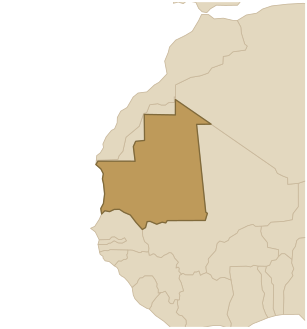
Mauritania is a vast country where the Maghreb meets sub-Saharan Africa, on the Atlantic coast, three-quarters covered by the Sahara. It is a bridge between two worlds: the Arab-Berber north and the sub-Saharan south, the desert and the river. Just over five million people live in this huge territory; the capital, Nouakchott, was founded in 1958 almost from nothing. A land of caravans, of ancient towns half buried in sand and of nomads, Mauritania keeps alive the world of the desert and its learning.
Geography
The Sahara dominates Mauritania: dunes as far as the eye can see, rocky plateaus, gravel plains and rare oases. In the middle of the desert lies a famous geological curiosity, the Eye of the Sahara (the Richat Structure), a huge set of concentric rings visible from space. The Atlantic coast, washed by a cold current rich in fish, borders the Banc d'Arguin, a haven for migratory birds. In the south, along the Senegal river, a thin strip of green, watered land holds most of the farming and much of the population.
History
This land was a great crossroads of trans-Saharan trade and a centre of Islam: it was from here that the Almoravid movement set out in the 11th century, building an empire from Senegal to Spain. Its caravan towns, such as Chinguetti and Ouadane, now World Heritage sites, were major stops and centres of religious learning, rich in libraries of old manuscripts. Colonised by France, Mauritania became independent in 1960. Standing between the Arab world and sub-Saharan Africa, it carries both the tensions and the riches of this double identity, and still deals with the legacy of slavery, abolished only in 1981 and made a crime in 2007.
Languages and faith
The official language is Arabic, spoken in a local form, Hassaniya; the peoples of the south speak Pular, Soninke and Wolof, languages of West Africa. Mauritania is an Islamic republic and one of the few entirely Muslim countries, with an old and deeply rooted Sunni Islam shaped by Sufi brotherhoods and a long tradition of religious scholarship, of which Chinguetti, regarded locally as a holy city, was a major centre.
Culture and way of life
Mauritanian culture is that of the desert and of nomadic life. There is life under the tent, green tea served in three rounds, and the welcome given to travellers. There is the music of the Moorish griots, played on the harp (ardin) and the lute (tidinit). There are silverwork, leatherwork and painted chests, and the old manuscripts of the desert towns. In the south the culture is West African, with its cloth and its music. Life revolves around the camel, Atlantic fish and millet.