Montserrat
A small British island in the Antilles nicknamed "the Emerald Isle of the Caribbean", with Irish and African roots, whose capital was destroyed by a volcano.
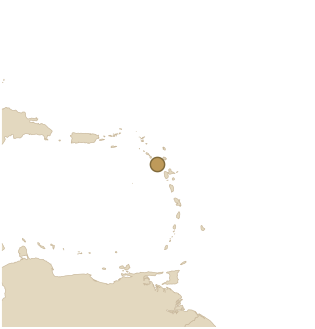
destroyed; seat of government at Brades
including a large exclusion zone
At a glance
Montserrat is a small British island in the Lesser Antilles, nicknamed "the Emerald Isle of the Caribbean" for its greenery and its Irish heritage. A British overseas territory, it has suffered a tragic fate: from 1995 the eruption of its long-dormant volcano destroyed the capital, Plymouth, and made the southern half of the island uninhabitable, driving two-thirds of the population away. About 4,400 people live there today, in the spared north, around the new administrative centre of Brades. Its population is mostly Afro-Caribbean.
Geography
Montserrat is a mountainous, green volcanic island, hence the "emerald" nickname. Its fate is ruled by the Soufrière Hills volcano, which woke up in 1995 after centuries of sleep. Its eruptions buried the former capital, Plymouth, under ash and flows, turning it into a "Pompeii of the Caribbean" frozen in hardened mud, and closed off a whole exclusion zone in the south. Life has retreated to the north, with its green hills, small black-sand beaches and bays. The tropical climate also exposes the island to hurricanes.
History
Home to the Kalinago, Montserrat was colonised from 1632 by Catholic Irish settlers, many of them fleeing persecution or transported, which gave the island its unusual character and its "Emerald Isle" nickname. Sugar cane plantations were built on the labour of enslaved Africans, from whom most of the population descends; Irish and African names and traditions mixed. After abolition in 1834 the island lived quietly from farming. Then came disaster: the volcanic eruptions of the late 1990s destroyed Plymouth and scattered much of the population.
Language and faith
Montserrat's language is English, spoken in a Caribbean Creole form with traces of its Irish heritage. The island is deeply Christian: the Catholicism of the first Irish settlers left a mark rare in the English-speaking Caribbean, alongside well-established Protestant churches (Anglican, Methodist, evangelical). Montserrat is one of the few places outside Ireland where St Patrick's Day is a public holiday; it honours both the Irish heritage and the memory of a slave uprising planned for that day in 1768.
Culture and way of life
Montserrat's culture is Afro-Caribbean, shaped by its Irish heritage and by the memory of the disaster. There are Caribbean music and dance, the traditional masquerade, whose costumes and steps mix African and European dance, and above all the St Patrick's festival, which lasts a week. Before the volcano, the island was also known for George Martin's AIR Studios, where major rock stars recorded. The Creole food centres on goat water (goat stew), the national dish, fish, rice and peas and tropical fruit.