Martinique
A French island in the Antilles, the "island of flowers", home of Mount Pelée, rum and a lively Creole culture, and of major voices in Caribbean thought.
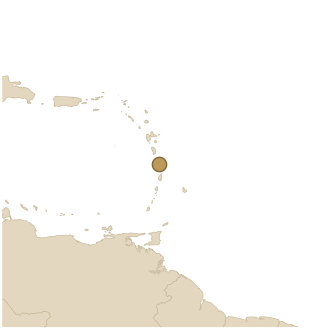
At a glance
Martinique is a French island in the Lesser Antilles, in the Caribbean Sea; as an overseas department and region, it is fully part of France and of the European Union. Nicknamed the "island of flowers", it is known for its beautiful landscapes of volcanic mountains, forests and beaches. About 350,000 people live there, around Fort-de-France; they form a Creole people shaped by the history of slavery and mixing. A land of rum, of biguine and of intense intellectual life, the home of Aimé Césaire, Frantz Fanon and Édouard Glissant, Martinique combines a deeply Caribbean culture with being part of France.
Geography
Martinique is a mountainous, green volcanic island. In the north rises Mount Pelée, a volcano with a grim reputation, surrounded by rainforest, peaks and rivers. The drier, rolling south has the finest beaches, low hills and lagoons, around the bay and rock of Le Diamant. Between the two, the plain and the capital line a large bay. Rainforest, mangrove, cane fields and banana plantations make for lush countryside. The hot, humid tropical climate has a rainy season and the threat of hurricanes.
History
Home to the Kalinago (Caribs), who are said to have called it Madinina, the island was reached by Columbus and colonised by France from 1635. Like all the Antilles, it lived under the sugar plantation system and slavery: hundreds of thousands of Africans were shipped there. Abolition in 1848, linked to the name of Victor Schœlcher, ended the system and was followed by the arrival of indentured workers from India. In 1902 the eruption of Mount Pelée destroyed Saint-Pierre, then the capital, killing nearly thirty thousand people in minutes. Martinique became a French department in 1946. Its history fed ideas read around the world: négritude, Caribbeanness and creoleness.
Language and faith
Martinicans speak French, the official language, and Martinican Creole, a French-based language born on the plantations, an expression of the island's identity and the medium of a rich literature. The island is mainly Catholic by tradition, with patron-saint feasts and processions. Alongside it survive beliefs from Africa mixed with Christianity, as well as a Hindu community, descended from the Indian indentured workers, and a Protestant one.
Culture and way of life
Martinican culture is Creole, born of the violent meeting of Africa and Europe, and its intellectual influence is great. There is biguine, bèlè with its drums inherited from the enslaved, zouk and carnival; above all, it is the home of Aimé Césaire, poet of négritude, of Frantz Fanon, and of Édouard Glissant, thinker of creolisation, who carried the Caribbean voice to the world. The food mixes flavours: colombo curry, accras, Creole black pudding, avocado féroce, and an agricultural rum that is the only one in the world with a protected designation of origin (AOC).