Mauritius
An Indian Ocean island settled from every continent, once home of the dodo, now a prosperous and peaceful country.
At a glance
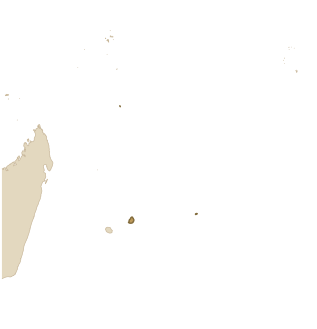
Mauritius is an island in the Indian Ocean, east of Madagascar, known for its beaches and lagoons. Like the other Mascarene islands, it was uninhabited before the Europeans arrived, so the Mauritian nation grew entirely out of peoples from several continents: India, Africa, Europe and China. This diversity makes it one of the most mixed and multicultural societies in the world, often held up as an example of harmony between communities. About 1.26 million people live there; the capital is Port Louis. Prosperous and stable, Mauritius is one of Africa's great success stories.
Geography
Mauritius is a volcanic island surrounded by a beautiful lagoon: an almost unbroken coral reef encloses turquoise water and white-sand beaches. Inland there are jagged mountains, plateaus covered in sugar cane, forests and waterfalls, and the coloured earths of Chamarel. The island was the only home of the dodo, a large flightless bird wiped out in the 17th century by humans and the animals they brought, which has become the world's symbol of extinction. The tropical climate, softened by the trade winds, puts the island in the path of cyclones.
History
An empty island, Mauritius was first Dutch (the dodo vanished in that period), then French, as Isle de France, which developed sugar cane with enslaved Africans and Malagasy, then British from 1810. After slavery was abolished in 1835, planters brought in nearly half a million indentured workers from India to cut the cane, which is why Indo-Mauritians are now the majority. Chinese traders joined them. Out of this mixing came the Mauritian nation, which won independence peacefully in 1968 and has prospered since; in 2025 the United Kingdom agreed to hand over sovereignty of the Chagos archipelago to it.
Languages and religions
The everyday language that unites the island is Mauritian Creole, born of French and enriched with African and Indian languages; French and English, the language of parliament, are widely used, and Indian and Chinese languages are heard too. Mauritius is an example of religious coexistence: Hinduism, the faith of nearly half the population, Christianity, Islam and Buddhism live side by side, and colourful temples, churches, mosques and pagodas stand next to each other. Each community's big festivals (Diwali, Christmas, Eid, Chinese New Year) are celebrated across the island.
Culture and way of life
Mauritian culture draws on several continents. Its best-known music is séga, born among enslaved Africans and Malagasy: song and dance to the beat of the ravanne drum, lively and on UNESCO's intangible heritage list. The food, probably the most mixed in the Indian Ocean, combines India, China, Africa and France: dholl puri, curry, fried rice and rougail, all richly spiced. Add to that the festivals of every community, rum and tea from the uplands.