Mayotte
A French island in the Comoros archipelago, in the Indian Ocean, a Muslim land with one of the largest lagoons in the world, where Africa, Madagascar and the Swahili world meet.
+ Shimaore, Shibushi
At a glance
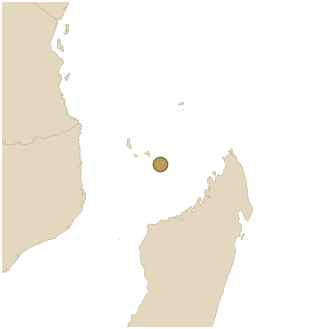
Mayotte is a French island in the Indian Ocean, the easternmost of the Comoros archipelago, between Africa and Madagascar in the Mozambique Channel. As an overseas department and region, it is part of France and the European Union; it voted to remain French when the rest of the Comoros became independent. About 320,000 people live there according to official estimates, probably more because of heavy immigration; the main town is Mamoudzou. It is an overwhelmingly Muslim, Comorian-speaking society with an African, Malagasy and Swahili identity, a French territory unlike any other. Mayotte is known for its huge lagoon.
Geography
Mayotte is an old, worn-down volcanic island of gentle green hills, surrounded by one of the largest enclosed lagoons in the world, protected by a double coral reef. The turquoise lagoon is full of marine life (turtles, dolphins, passing whales, dugongs). The land, with its hills, mangroves, beaches and forests, grows baobabs, fragrant ylang-ylang and food crops. The tropical climate alternates between dry and rainy seasons, and the island is exposed to cyclones such as Chido, which devastated it in December 2024.
History
Settled over the centuries by Bantu peoples from East Africa, by Malagasy and by Swahili and Arab traders who brought Islam, Mayotte was ruled by sultanates. In 1841 a sultan ceded it to France, which made it a colony and developed plantations. When the Comoros became independent in 1975, Mayotte voted to remain French, a choice still disputed by the Union of the Comoros. In 2011, after another referendum, it became France's 101st department, while keeping strong cultural and religious traits of its own.
Language and faith
In Mayotte, French is the official language and the language of school, but people mostly speak Shimaore, a Bantu language close to Swahili, and Shibushi, which is of Malagasy origin. The island is overwhelmingly Sunni Muslim: Islam, rooted here for centuries, shapes daily, family and social life, with its mosques, Koranic schools and festivals. This Mahoran Islam, often coloured by local traditions and Sufi brotherhoods, coexists with the secularism of the French state.
Culture and way of life
Mahoran culture is Swahili and Muslim, blending African, Malagasy and Arab heritage. There is m'biwi, women's songs and dances that liven up celebrations, the déba, a religious dance, and the great traditional weddings, the manzaraka, which last several days and are central to social life. There is also msindzano, the ochre beauty mask women wear, colourful clothes, ylang-ylang and vanilla. The food mixes spices and fish from the lagoon: mataba (pounded cassava leaves), plantains and coconut rice.