Namibia
Home of the oldest desert in the world and of dunes that run down to the ocean, a land of wide open spaces and of some of humanity's oldest peoples.
+ English
At a glance
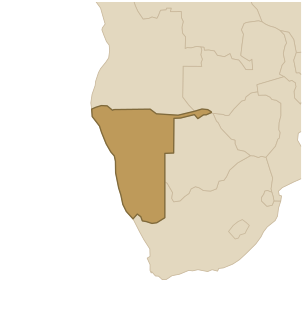
Namibia is a vast country in Southern Africa, on the Atlantic, and one of the most thinly populated on Earth: only about three million people live in a country one and a half times the size of France; the capital is Windhoek. It is a land of deserts and wide open spaces under very bright light, named after the Namib Desert. A German colony and then run by South Africa, Namibia only became independent in 1990, making it one of Africa's youngest nations.
Geography
The country is framed by two deserts. In the west, the Namib, the oldest desert in the world, lines the Atlantic with giant dunes of deep orange, among the highest on Earth, such as those at Sossusvlei; further north they run straight into the ocean. Where the desert meets the cold sea lies the Skeleton Coast, wrapped in fog and strewn with wrecks. To the east stretches the Kalahari. Between the two, a high plateau of savanna and bush is home to abundant wildlife, as at Etosha National Park around its great salt pan.
History
Namibia has been home since very ancient times to the San, hunter-gatherers whose lineages are among the oldest in humanity and whose rock paintings have decorated the landscape for thousands of years. Then came the Khoikhoi herders, followed by Bantu peoples such as the Ovambo and the Herero. German colonial rule in the late 19th century was marked by the extermination of the Herero and Nama between 1904 and 1908, often called the first genocide of the 20th century and acknowledged by Germany in 2021. Later run by South Africa, which imposed apartheid, the country won independence in 1990 after a long struggle; in 2024 it elected its first woman president, Netumbo Nandi-Ndaitwah.
Languages and faith
Namibia is a mosaic of languages: Oshiwambo, spoken by the largest group, other Bantu languages, Afrikaans and German from the colonial past, and the click languages of the San and Nama. English was chosen as a neutral official language to unite the nation. The country is overwhelmingly Christian, mostly Lutheran, a trace of the German presence, a faith that sits alongside respect for tradition and ancestors.
Culture and way of life
Namibian culture is as varied as its peoples. There are the Herero women, in Victorian dresses and headdresses shaped like cow horns, a fashion taken from the colonisers and turned into a mark of identity; the Himba women of the north, their skin and hair coated in red ochre, who keep to an ancestral way of life; and the knowledge of the San, masters of the desert and of tracking. There are also the dunes, one of the clearest starry skies in the world and a herders' cuisine of meat and game.