New Caledonia
A large French island in Melanesia with one of the largest lagoons in the world, home of the Kanak people and of a mixed society, with nickel, reefs and an open question about its future.
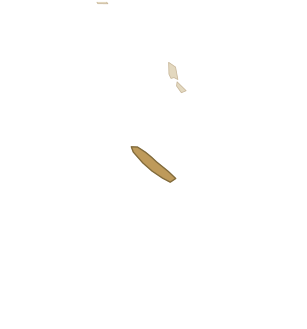
+ 28 Kanak languages
At a glance
New Caledonia is a group of French islands in the South Pacific, in Melanesia, east of Australia, with a special status and wide self-government. It is made up of a large mountainous island, the Grande Terre, and smaller islands including the Loyalty Islands, and is surrounded by one of the largest lagoons in the world, a World Heritage site. About 270,000 people live there, around Nouméa. The population is mixed: the Indigenous Melanesian Kanak people, descendants of European settlers (the Caldoches), Wallisians, Tahitians and Asians. Rich in huge nickel deposits, New Caledonia has spent decades seeking its institutional future.
Geography
New Caledonia is dominated by the Grande Terre, a long island split by a mountain range that separates a wet, green east coast from a drier west coast of savanna and cattle country. The nickel-rich soil gives some land a distinctive red colour and supports plants found nowhere else. All around lies a vast lagoon, often described as the largest enclosed lagoon in the world, protected by a long barrier reef and teeming with marine life. The flat coral Loyalty Islands and the Isle of Pines add their beaches and columnar pines. The climate is tropical, tempered by the trade winds.
History
The ancestors of the Kanak people settled these islands more than three thousand years ago, as part of the great Austronesian movement of the Lapita potters. Reached by James Cook in 1774, the island was taken by France in 1853. Napoleon III made it a penal colony: more than twenty thousand convicts, including Communards, were sent there. Colonisation, nickel mining and the seizure of Kanak land caused deep tensions, culminating in the violent "Events" of the 1980s. The Matignon and then Nouméa accords opened a process of negotiated decolonisation. Three independence referendums were held between 2018 and 2021, and deadly riots broke out in 2024: the territory's future remains at the heart of local life.
Language and faith
In New Caledonia, French is the official and shared language, but the Kanak people speak twenty-eight languages and many dialects, which now enjoy more recognition. Most people are Christian, Catholic or Protestant, since the missionary work of the 19th century, and faith plays an important part in community life. Among the Kanak, this Christianity blends with deep respect for custom, a spiritual and social foundation built on ties to the land, the ancestors and the clan, which governs much of traditional life.
Culture and way of life
New Caledonian culture is first of all that of the Kanak people, built on custom, the clan and ties to the land. There is the traditional great hut with its carved roof spire, the customary gesture, a gift offered as a sign of respect on arrival, the pilou dances and the yam, a sacred plant. The Tjibaou Cultural Centre, designed by Renzo Piano, is its modern symbol. Mixed with this are the cultures of the Caldoches (the bush and cattle-ranching way of life), of the Wallisians and of the Asian communities. People share bougna (meat and root vegetables steamed in banana leaves), venison, seafood and flavours from around the world.