Norfolk Island
A small Australian island in the South Pacific, once a penal colony and then home to the descendants of the Bounty mutineers, known for its tall pines.
At a glance
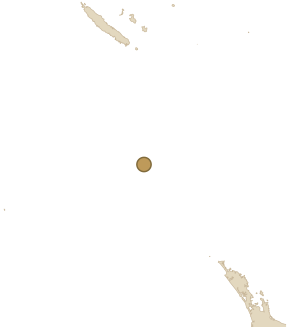
Norfolk Island is a small, remote island in the South Pacific, between Australia, New Zealand and New Caledonia. A territory of Australia, it has about 2,200 inhabitants; the historic main town is Kingston. Its history comes in two parts. First it was one of the harshest penal colonies in the British Empire. Then, in 1856, the Crown moved the entire population of Pitcairn there, as it had outgrown its own island: the descendants of the Bounty mutineers and their Tahitian companions. Many islanders still descend from them, with names such as Christian and Adams. Home of the tall Norfolk pines, the island keeps an identity distinct from mainland Australia.
Geography
Norfolk Island is a small volcanic island of gentle green landscapes, rolling hills, pastures and high cliffs dropping into the Pacific. It is known for its tall Norfolk pines, slender, symmetrical trees that have become its emblem. With no proper harbour, getting ashore by sea is still tricky. Two small uninhabited islands, Nepean and Phillip, lie nearby. The mild subtropical climate favours lush growth, and the surrounding waters are rich in marine life.
History
Once home to Polynesians, who had vanished long before the Europeans arrived, Norfolk was occupied by the British from 1788 as a penal colony and later abandoned. Reopened in 1825, it became a second penal settlement, notorious for its brutality and reserved for the worst convicts, until it closed in 1855. In 1856 the Crown offered the empty island to the whole population of Pitcairn: the descendants of the Bounty mutineers and their Tahitian companions, crowded on their rock, were moved there. Many settled for good, bringing their language and traditions. Run by Australia, the island long had wide self-government, abolished in 2016, and it guards its identity and its Bounty heritage.
Language and faith
People on Norfolk Island speak English and Norfuk, a Creole inherited from the Pitcairners that mixes 18th-century sailors' English with Tahitian; a cousin of Pitkern, it is protected as the heart of the island's identity. The island is Christian by tradition, divided between Anglicans, Methodists and other churches, and faith has accompanied the history of the Bounty descendants. The old churches and stone buildings of Kingston, relics of the convict era and now a World Heritage site, also bear witness to this past.
Culture and way of life
Norfolk Island's culture is unique, born of the meeting of the Bounty heritage, English and Tahitian, with the convict past. You can see it in the mutineers' surnames still in use, in the Norfuk language and in traditions brought from Pitcairn: dance, songs and cooking that mixes the two worlds. Islanders celebrate Bounty Day (or Anniversary Day), which marks the arrival of the Pitcairners, in period costume. The food uses what the island and the sea provide: fish, bananas, taro and pilhi, a dish brought from Pitcairn.