Nicaragua
The largest country in Central America, a land of lakes and volcanoes, the "land of poets" between two oceans.
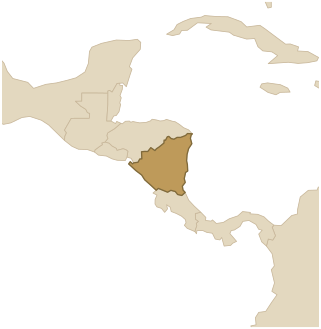
At a glance
Nicaragua is the largest country in Central America, with the Pacific to the west and the Caribbean Sea to the east. It is a land of lakes and volcanoes, which are its symbol. About seven million people live there, around the capital, Managua, and the colonial cities of León and Granada. It is nicknamed the "land of poets", so highly is poetry honoured there. Its history has been shaped by dictatorships, a revolution and violent earthquakes.
Geography
The west of the country is a land of fire and water: a chain of active volcanoes runs along the Pacific above two large lakes. The bigger one, Lake Nicaragua, is a true freshwater inland sea, the largest in Central America; on it stands the island of Ometepe, made of two twin volcanoes, and it is even home to sharks that can live in fresh water. The cool, mountainous centre is coffee country. To the east lies the Mosquito Coast, a vast Caribbean region of rainforest, lagoons and rivers, long isolated and culturally distinct.
History
Home in the west to Nahua peoples, related to the Aztecs, and on the Caribbean coast to peoples of other languages and cultures, the region was colonised by Spain, which founded León and Granada there in 1524, among the oldest European cities in the Americas. Independent from 1821, Nicaragua long lay under the dictatorial Somoza dynasty, overthrown in 1979 by the Sandinista revolution. In the 1980s a civil war pitted the new government against the "Contras", backed by the United States. Back in power since 2007, the Sandinista Daniel Ortega harshly crushed the 2018 protests and has ruled in an authoritarian way ever since.
Language and faith
Nicaraguans speak Spanish, in a form marked by voseo and by Indigenous words; on the Caribbean coast people also speak an English Creole and the languages of peoples such as the Miskito. The country is mainly Christian, Catholic by tradition with a growing evangelical presence; big patron-saint festivals such as La Purísima, devoted to the Virgin, are high points of the year. On the coast the Moravian Church dominates, a legacy of its separate history.
Culture and way of life
Nicaraguan culture takes pride in its poetry: the country gave the Spanish language one of its greatest poets, Rubén Darío, father of modernismo, revered as a national hero. There is also the danced theatre of El Güegüense, a colonial satire mixing Spanish and Nahuatl, on UNESCO's intangible heritage list. There are the colonial towns with their colourful façades, crafts, the marimba and festivals. At the table there is gallo pinto (rice and beans), nacatamal and dishes of maize and plantain.