Netherlands
A small country in northwestern Europe won from the sea, a land of canals, bicycles and tolerance, which in the 17th century was one of the great powers of the world.
seat of government: The Hague
+ Frisian
At a glance
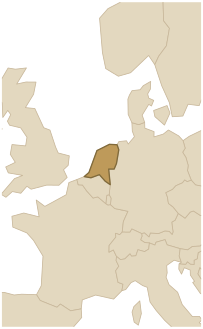
The Netherlands (often called Holland for short) is a small, flat country in northwestern Europe, on the North Sea. Its name says it all: these are the "low countries", so low that about a quarter of the land lies below sea level. The Dutch have literally built their country on water, taking it from the sea with dikes, canals and windmills. About 18 million people live there, very densely, in cities such as Amsterdam, The Hague and Rotterdam, Europe's largest port.
Geography
There are no mountains in the Netherlands and hardly any hills: the country is a vast delta where great rivers (the Rhine, the Meuse) flow into the North Sea. Much of the land, the polders, has been drained and won from the water over the centuries, protected by one of the cleverest systems of dikes in the world. It is a gentle, orderly landscape of gridded fields, canals, windmills and, in spring, huge fields of brightly coloured tulips. "God created the world, but the Dutch created the Netherlands," as the saying goes.
Peoples and history
Long divided among rich trading cities, the region rose up against Spanish rule in the 16th century and won its independence. Then came the Golden Age: in the 17th century this small country became the world's leading trading power. Its ships and its East India Company sailed every ocean, Amsterdam had one of the first modern stock exchanges and, wealthy and tolerant, took in the persecuted from all over Europe. It was the age of Rembrandt and Vermeer, high points of painting. The country built a colonial empire, in Indonesia, Suriname and the Caribbean, and played a large part in the Atlantic slave trade, before becoming the open, prosperous nation of today, a founding member of the European project.
Language and religion
Dutch is a Germanic language, a close cousin of German and English, and the Dutch are known for speaking several languages fluently; Frisian is also official in the province of Friesland. After the Reformation the country was deeply shaped by Calvinist Protestantism in the north and Catholicism in the south, a divide that long structured society. Today the Netherlands is one of the most secular and liberal countries in the world, true to its old tradition of tolerance and freedom of conscience.
Culture and way of life
The Netherlands has an instantly recognisable identity: the land of the bicycle, king of the roads, of canals explored by boat and of narrow gabled houses. It is the homeland of great painters, from Rembrandt to Van Gogh. Its culture is practical, direct and egalitarian, and people value gezelligheid, a warm, cosy togetherness that is hard to translate. At the table there are the famous cheeses (Gouda, Edam), herring and stroopwafels; and a national passion for football, the football of Cruyff and "total football".