Norway
The land of fjords and the midnight sun, a Viking homeland in the far north of Europe that has become one of the world's most prosperous nations, and one of the most attached to nature.
+ Sami
At a glance
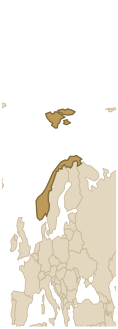
Norway occupies the western side of Scandinavia, a long ribbon of land stretching toward the Arctic along a deeply indented coast. It is a country of mountains, sea and wide open spaces where, in the far north, the sun does not set for part of the summer and does not rise for part of the winter. Only about five and a half million people live there, most of them in the milder south, around the capital, Oslo. Thanks to North Sea oil, whose revenues feed the largest sovereign wealth fund in the world, Norway has become one of the richest countries on Earth.
Geography
Norway's signature is its fjords: deep, narrow arms of the sea carved by glaciers between towering cliffs and reaching far inland. The interior is a high plateau of mountains, glaciers and tundra. To the north, beyond the Arctic Circle, lie the lands of the midnight sun and the northern lights, up to the North Cape. The coast, scattered with thousands of islands, is warmed by the Gulf Stream, which softens what would otherwise be an icy climate.
Peoples and history
Norway is one of the homelands of the Vikings. From its fjords, more than a thousand years ago, these daring seafarers set out in their longships to raid and trade across Europe, but above all to explore the Atlantic: they settled Iceland and Greenland and reached America five centuries before Columbus. Converted to Christianity around the year 1000, Norway was later joined for a long time to Denmark and then to Sweden, before regaining full independence in 1905. The discovery of oil in the late 1960s turned this country of fishermen and farmers into one of the most prosperous nations on Earth.
Language and religion
Norwegian is a North Germanic language so close to Swedish and Danish that their speakers understand each other almost effortlessly, a legacy of the Vikings' old language, Old Norse. In the far north live the Indigenous Sami, with their own language and reindeer-herding culture. After the Reformation the country became deeply Lutheran, but today it is one of the most secular societies in the world.
Culture and way of life
Norwegians live very close to nature: they even have a word, friluftsliv, "open-air life", for their need for mountains, forest and sea, summer and winter alike. Modern skiing was born in the Telemark region, and the country excels at it. Norway gave the world the painter Munch and his Scream, the composer Grieg, the explorer Amundsen, the first man to reach the South Pole, and the playwright Ibsen. At the table there is salmon, dried fish, brown cheese and berries picked on the tundra.