Nepal
The roof of the world, land of Everest and of the gods, birthplace of the Buddha and of a mountain civilisation between India and Tibet.
+ many languages
At a glance
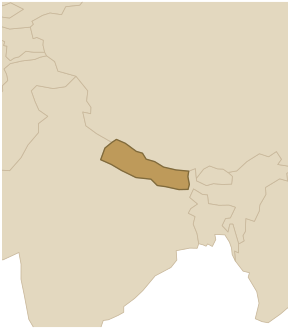
Nepal is a mountain country squeezed between Asia's two giants, India and China (Tibet). It is the land of the Himalayas: eight of the ten highest peaks on Earth stand on its soil, including the highest of all, Everest. This extreme geography forged a mountain civilisation between the Indian and Tibetan worlds that was never colonised. About thirty million people live there; the capital, Kathmandu, lies in a valley full of temples. It is also sacred ground: the Buddha was born here.
Geography
The country reads from south to north like a climb into the sky. In the south, a narrow strip of tropical plain, the Terai, continues the hot, fertile plain of India. Further north the land rises into green hills and middle mountains, where most people live and where Kathmandu sits. Then, in the far north, comes the wall of the Himalayas, with its snowy giants, glaciers and high valleys home to herding peoples. Within a few dozen kilometres you go from jungle to permanent snow.
Peoples and history
Nepal holds a unique place in the world's spiritual history: it was at Lumbini, on its southern plain, that Prince Siddhartha Gautama, the future Buddha, was born about two and a half thousand years ago. The Kathmandu valley saw refined kingdoms flourish, whose Malla kings filled the towns with temples and palaces of carved wood. The country was unified in the 18th century by the kings of Gorkha and kept its independence from the British, who were so impressed by the courage of the Gurkha soldiers that they recruited them. Long the world's only Hindu kingdom, Nepal became a republic in 2008; in 2015 an earthquake killed nearly nine thousand people.
Languages and faith
Nepali, an Indo-European language related to Hindi, is the common language of many peoples who speak dozens of tongues. In Nepal, Hinduism, the majority faith, and Buddhism are so closely entwined that they often share temples and gods. Kathmandu is a great sacred centre, crowded with temples and stupas with painted eyes, such as Boudhanath, hung with prayer flags. In several towns of the valley a young girl, the Kumari, is still worshipped as a living goddess.
Culture and way of life
Nepalese culture is made of mountains and faith. The country is the world's great destination for mountaineering and trekking, and the Sherpas, a people of the high valleys, guide those who climb Everest. Life follows a calendar of colourful religious festivals. The everyday meal is dal bhat, rice and lentils with vegetables, and everyone loves momos, dumplings from Tibet.