New Zealand
The land of the "long white cloud" at the far end of the Pacific, home of the Māori and their seafaring ancestors, famous for its mountains, glaciers and fjords.
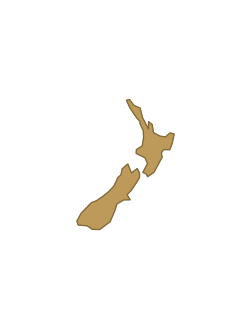
largest city: Auckland
+ sign language
At a glance
New Zealand is an island country in the South Pacific, one of the most isolated in the world, thousands of kilometres from any other continent. It is made up of two large islands, the North Island and the South Island, and many smaller ones. The Māori, its first inhabitants, call it Aotearoa, "the land of the long white cloud". Just over five million people live there, around Auckland and the capital, Wellington. It is a young, prosperous and peaceful nation, born of the meeting of the Polynesian Māori and European settlers, whose landscapes served as the setting for The Lord of the Rings.
Geography
The South Island is crossed by the Southern Alps, a range of snowy peaks, glaciers and fjords plunging into the sea, such as Milford Sound. The warmer, more populous North Island is a land of active volcanoes: geysers, boiling springs and coloured lakes, especially around Rotorua. Everywhere there are vivid green hills, ancient forests, beaches and wildlife found nowhere else, including the kiwi, a flightless bird that has become the national emblem.
History
New Zealand was one of the last large habitable lands to be settled: the Māori, Polynesian seafarers, arrived by canoe only about seven centuries ago, at the end of one of the most extraordinary sea voyages in history. Europeans came much later; in 1840 the British Crown and Māori chiefs signed the Treaty of Waitangi, the founding text of the modern nation but a source of lasting conflict. First a colony, then a dominion, the country was ahead of its time: in 1893 it became the first self-governing country to give women the vote.
Languages and faith
New Zealand has two official languages, Māori (te reo), a Polynesian language now being actively revived and increasingly present in public life, and New Zealand Sign Language; English, spoken by almost everyone, is the everyday language. The country is Christian by tradition, a legacy of colonisation, but very secular: a large share of the population now says it has no religion. Māori spirituality, with its sacred bond to the land, the ancestors and nature, increasingly shapes the shared identity.
Culture and way of life
New Zealand culture joins Māori heritage with the English-speaking world, in an identity increasingly proud of both roots. There is the haka, a powerful war dance of stamping and chanting that the whole world knows through the All Blacks, the rugby team that is almost a national religion. There are sacred tattoos (tā moko), carvings, the pressing of foreheads and noses in greeting (the hongi) and the earth-oven feast, the hāngī. And there is a love of the outdoors, hiking and extreme sports.