Oman
A sultanate of mountains and deserts at the tip of Arabia, once a seafaring empire of incense and sailors, which has kept its heritage.
At a glance
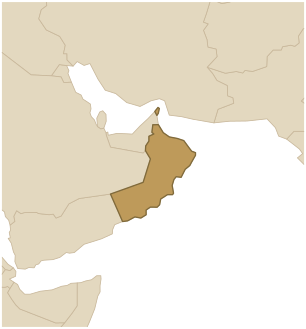
Oman occupies the southeastern tip of the Arabian peninsula, facing the Arabian Sea and guarding the Strait of Hormuz, the gateway to the Persian Gulf. It is a sultanate, ruled by the same dynasty since the 18th century and known for its stability and diplomatic neutrality. About five million people live there; the capital, Muscat, is a low white city between sea and mountains. Unlike its neighbours with their glass towers, Oman has developed in a way that respects its heritage: mud-brick forts, souks and a seafaring tradition.
Geography
Oman's landscapes are very varied. In the north the Hajar mountains rise in dry peaks and canyons, at the foot of which oases are watered by clever ancient channels, the aflaj, a World Heritage site. Inland lies the great Rub' al-Khali, the "Empty Quarter", one of the largest sand seas on Earth. On the coasts there are beaches, the fjords of Musandam and turtle nesting sites. In the far south, the Dhofar region has something unique in Arabia: every summer the monsoon (the khareef) covers it in mist and greenery.
History
From antiquity Oman prospered on the frankincense of Dhofar, a precious resin sold across the ancient world, and on the copper of its mountains. A great seafaring people, the Omanis led a maritime empire in the 17th to 19th centuries along the coasts of Persia, Balochistan and East Africa, with Zanzibar as a second capital; deep ties with the Swahili world and the Indian Ocean remain. Inward-looking and poor in the early 20th century, the country modernised from 1970 under Sultan Qaboos, who was succeeded in 2020 by Sultan Haitham.
Language and faith
Omanis speak Arabic, alongside languages from their seafaring past, such as Swahili, brought back from East Africa, and Balochi. Oman has a rare religious feature: much of its population follows Ibadism, a branch of Islam distinct from both Sunni and Shia Islam, known for its moderation and its emphasis on consensus. Ibadi Islam has strongly shaped the open, hospitable Omani character and its coexistence with the country's other communities.
Culture and way of life
Omani culture blends desert, mountain and sea. There is the scent of frankincense burning in homes, rose water and the souks of Muscat and Nizwa. There is the khanjar, the engraved curved dagger worn at the waist, the national emblem. There are hundreds of mud-brick forts, silverwork and dhows, the traditional sailing boats. Every guest is offered cardamom coffee and dates; for festivals, families make shuwa, spiced lamb slow-cooked for a day or two in an underground oven.