Pakistan
The land of the Indus Valley, one of the oldest civilisations in the world, a crossroads of peoples between Central Asia, Persia and India.
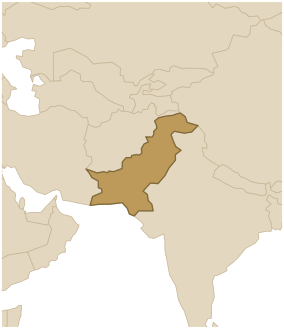
largest city: Karachi
5th most populous country
+ Punjabi, Sindhi, Pashto…
At a glance
Pakistan occupies the northwestern corner of the Indian subcontinent, where three worlds meet: Central Asia, the Iranian plateau and India. The fifth most populous country on Earth, with some 240 million people, it was created in 1947 as a homeland for the Muslims of British India. Its name means "land of the pure". The country lives by a river, the Indus, which gave it its ancient civilisation and its farming.
Geography
The country is a land of extremes. In the north stand some of the highest mountains on Earth: the Karakoram and K2, the world's second-highest peak, where three great ranges meet. From there the Indus flows down through the whole country, forming with its tributaries a vast farming plain, Pakistan's breadbasket. To the west lie the dry uplands of Balochistan, stretching toward Iran and Afghanistan; to the southeast, the Thar Desert; and in the far south, the Indus reaches the Arabian Sea near the megacity of Karachi.
Peoples and history
It was here, four and a half thousand years ago, that the Indus Valley Civilisation flourished, with its carefully planned brick cities, Mohenjo-daro and Harappa: one of the world's three oldest urban civilisations, along with Egypt and Mesopotamia. The region then became a crossroads: Persian, Greek after Alexander, then a great centre of Buddhism with the refined art of Gandhara. Islam arrived from the south in the 8th century, then with conquerors from Central Asia, up to the Mughals. In 1947 the end of British India gave birth to Pakistan in a vast and painful Partition, one of the largest migrations in history. Its eastern wing broke away in 1971 to become Bangladesh.
Peoples, languages and faith
Pakistan brings together several large peoples: the Punjabis, the most numerous, the Sindhis of the river, the Pashtuns of the western mountains and the Baloch. The national language is Urdu, a language of culture and poetry, but each people keeps its own, and English is used in government. The country is almost entirely Muslim, mostly Sunni with a large Shia minority, and deeply shaped by Sufism: the shrines of the great saints draw huge crowds of devotees.
Culture and way of life
Its Sufi music, qawwali, carried around the world by the voice of Nusrat Fateh Ali Khan, is a song of religious ecstasy. Cricket is a national passion. The food is richly spiced: biryanis, kebabs, curries and naan hot from the oven. And there is the exuberant art that covers the country's trucks in a riot of colour.