Panama
The bridge between the two Americas and the canal that joins two oceans, a crossroads of the world, a land of forests and of mixed peoples.
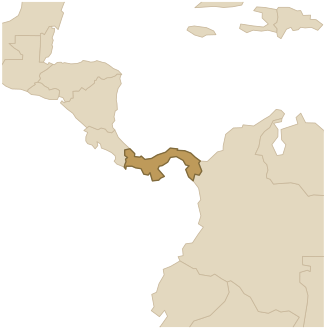
At a glance
Panama is the narrow strip of land that links North and South America, the bridge between the two continents, between the Pacific Ocean and the Caribbean Sea. The isthmus is so narrow here that people were able to cut through it one of the greatest engineering works in history, the Panama Canal, which joins the two oceans and carries a significant share of world shipping. About 4.5 million people live there; the capital, Panama City, is a modern city. It is a deeply mixed and cosmopolitan nation.
Geography
Panama stretches in a long, curved isthmus, so narrow that you can get from the Pacific to the Caribbean in a few hours. A chain of mountains and volcanoes runs through it, covered in rainforest among the richest in species in the world: across this natural bridge, the wildlife of the two Americas has mixed for three million years. Both coasts are scattered with islands and reefs, such as the San Blas archipelago. To the east, the Darién, an impenetrable jungle, is the only gap in the road linking the two Americas.
History
From the conquest onward, the isthmus was a key place: crossing it in 1513, the Spaniard Balboa became the first European to see the Pacific from the Americas. Panama became the route by which silver from the Andes reached Spain, attracting pirates and rivals. Long part of Colombia, it broke away in 1903 with the backing of the United States, which immediately began digging the canal, finished in 1914 at the cost of thousands of lives. After the 1989 American invasion that toppled General Noriega, the canal was handed back to Panama in 1999 and has become the engine of its prosperity.
Language and faith
Spanish is spoken in Panama, but this cosmopolitan crossroads also echoes with English, Caribbean Creoles and the languages of its Indigenous peoples: the Guna, the Emberá and others, some of whom live in self-governing territories. The country is mostly Catholic, with a notable Protestant presence, especially among the Afro-Caribbean communities who came to build the canal. Faith, patron-saint festivals and carnival set the rhythm of life.
Culture and way of life
Panamanian culture is that of a crossroads. There is the mix of peoples: Indigenous, Spanish, Afro-descendants (from the Caribbean or descended from the enslaved), and the descendants of workers who came from all over the world to dig the canal. There are molas, layered cloth panels in bright patterns, made by Guna women. There is the pollera, the embroidered festival dress, típica music and salsa, and one of the liveliest carnivals in the Americas. At the table there is sancocho (chicken soup), rice, seafood and fried plantain.