Peru
The land of the Andes and the Incas, one of the cradles of civilisation, where desert, high mountains and the Amazon meet.
+ Aymara
At a glance
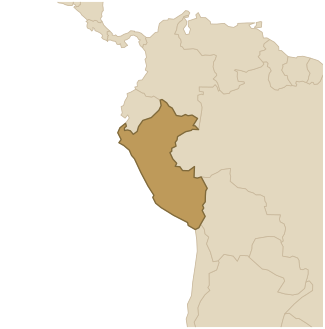
Peru lies in the middle of South America's Pacific coast, dominated by the great range of the Andes. It is a land of extreme contrasts and was the heart of the largest empire of the pre-Columbian Americas, that of the Incas. About 34 million people live there, many of them on the desert coast around the capital, Lima. Its Indigenous history is so old that it makes this land one of the few cradles of human civilisation.
Geography
The country falls into three parallel strips. Along the Pacific runs a narrow desert coast, one of the driest deserts in the world, crossed by only a few rivers. Then the land rises sharply into the high Andes, with their snowy peaks, frozen high plateaus and valleys, where the potato was first domesticated. Finally, beyond the crest, the mountains drop down to the vast Amazon rainforest, which covers more than half the country.
Peoples and history
Peru's history is one of the oldest in the Americas. Caral, built nearly five thousand years ago, was one of the first cities in the world, contemporary with the pyramids of Egypt. Great civilisations followed: the Moche, with their goldwork, the Nazca, with their huge lines drawn in the desert, and the Wari. In the 15th century the Incas, from Cusco, unified a vast empire linked by thousands of kilometres of roads; the mountaintop city of Machu Picchu is its best-known site. In 1532 a handful of Spanish conquistadors led by Pizarro seized it. From the painful meeting of the two worlds came today's mestizo people.
Languages and faith
Peruvians speak Spanish, but also the Indigenous languages of the Andes, which are also official: Quechua, the language of the Incas, still spoken by millions, and Aymara, around Lake Titicaca. The country is overwhelmingly Catholic, with a Catholicism deeply mixed with Andean beliefs: people still honour the Pachamama, Mother Earth, make offerings to the sacred mountains, and celebrate the great Christian feasts with Andean dances and costumes.
Culture and way of life
Peruvian culture is that of the Andes: brightly coloured textiles woven for thousands of years, the music of panpipes and the quena flute, colourful markets. Peru has also become one of the world's great food destinations: its cooking combines produce from the sea, the mountains and the forest. Ceviche, raw fish cured in lime juice and on UNESCO's intangible heritage list, is its best-known dish; and the potato, first grown here, comes in thousands of varieties.