Philippines
A vast Southeast Asian archipelago, Asia's largest Christian nation, born of the meeting of the Malay world, Spain and America.
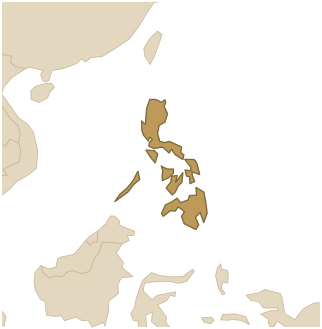
~7,600 islands
+ ~180 languages
At a glance
The Philippines is a vast tropical archipelago on the eastern edge of Southeast Asia, made up of more than seven thousand islands scattered between the Pacific and the South China Sea. About 113 million people live there, across three main groups: Luzon in the north, home to the capital, Manila, the Visayas in the centre and Mindanao in the south. Along with Timor-Leste, it is one of the two mainly Christian countries in Southeast Asia, the result of three centuries of Spanish rule.
Geography
Like neighbouring Indonesia, the Philippines sits on the Pacific Ring of Fire: the country has many volcanoes, including Mayon, famous for its perfect cone, and earthquakes are frequent. The nature is lush and tropical: rice terraces carved into the mountainsides centuries ago, white-sand beaches and turquoise water, forests and very rich coral reefs. Every year the country is also on the front line of the great Pacific typhoons.
Peoples and history
The islands were settled thousands of years ago by the Austronesians, the great seafaring people, who had been preceded by very ancient inhabitants, the Negritos. Before the Europeans came, it was a world of small coastal city-states and, in the south, Muslim sultanates. In 1565 Spain conquered the islands, which already bore the name of the future King Philip II. For three centuries Spain ruled them and converted them to Catholicism, making Manila a stopover in trade between Asia and the Americas. In 1898 the United States took over, after a Philippine revolution and a war, leaving behind English and many American habits. Independent in 1946, the country lived under Ferdinand Marcos's dictatorship until it was peacefully overthrown in 1986.
Languages and religion
Some one hundred and eighty languages are spoken in the Philippines, almost all of them Austronesian. To unite the country, a national language was chosen, Filipino, based on the Tagalog of Manila, alongside widely spoken English. The country is overwhelmingly Catholic, a legacy of Spain, and its religious festivals are among the most fervent in the world; a large Muslim minority lives in the south, on Mindanao, which long stayed out of Spanish control.
Culture and way of life
Philippine culture is a blend. It has a Malay base, Spanish devotion and first names, and an American taste for basketball and pop. People value mutual help, bayanihan, and love karaoke and big village fiestas. The food has a sweet-and-sour character all its own: adobo, festive lechon and an abundance of tropical fruit. A huge diaspora works all over the world and supports many families back home.