Palau
An emerald archipelago in the western Pacific, a haven for nature and diving and a world pioneer in protecting the ocean.
At a glance
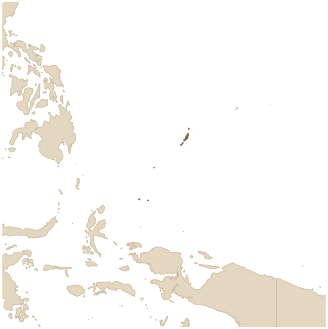
Palau is a small archipelago in the western Pacific, east of the Philippines, made up of more than three hundred islands, only a handful of them inhabited. With barely eighteen thousand people, it is one of the smallest countries in the world; its capital, Ngerulmud, is one of the least populated on the planet. Palau is famous for its waters: its lagoons, reefs and mushroom-shaped islets are among the best diving sites on Earth. A pioneer in conservation, it has made protecting its ocean national policy and bans commercial fishing in about 80% of its waters.
Geography
Palau is an archipelago of several hundred islands. The best known are the Rock Islands: hundreds of forested limestone islets shaped like mushrooms, rising from a turquoise lagoon, a World Heritage site. Here too is Jellyfish Lake, a marine lake where you can swim among millions of jellyfish whose sting is almost harmless. The coral reefs are full of sharks, manta rays and fish, in very clear water. The main islands are volcanic and green. The climate is tropical.
History
Settled thousands of years ago by Austronesian seafarers, Palau developed a refined matrilineal society organised around clans and carved meeting houses. Like its Micronesian neighbours, the islands came under Spanish, German and then Japanese rule. In the Second World War the island of Peleliu was the scene of an extremely violent battle between the Americans and the Japanese. Placed afterwards under American trusteeship, Palau became independent in 1994, in free association with the United States.
Language and faith
People speak Palauan, an Austronesian language, alongside English, which is also official; Japanese has left a few words behind from the occupation. Palau is mainly Christian, Catholic and Protestant since the missionaries came, but it also has a local religion born in the 20th century, Modekngei, which mixes Christianity with traditional beliefs. Respect for clans, chiefs and above all women, in this traditionally matrilineal society, remains at the heart of social life.
Culture and way of life
Palauan culture is that of a sea-going, matrilineal society in which women hold the land and the titles. Its symbol is the bai, the men's meeting house, whose gables are covered with paintings and carvings telling the legends of the islands. There are also storyboards, carved wooden panels that tell the myths, along with navigation, fishing and deep knowledge of the sea. Palau is proud of a conservation ethic inherited from the bul, a tradition that periodically banned fishing so the sea could recover. Life revolves around taro, fish and coconut.