Papua New Guinea
One of humanity's oldest homelands and the country with the most languages in the world: a world long kept apart from all others.
Tok Pisin, English, Hiri Motu
At a glance
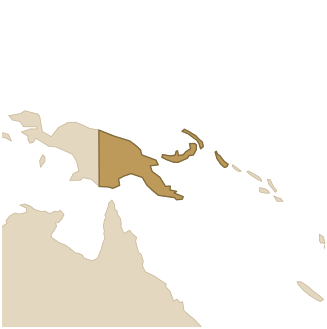
Papua New Guinea occupies the eastern half of New Guinea (the second-largest island in the world, after Greenland) and hundreds of other islands, north of Australia. Some ten million people live there, scattered across valleys and islands long cut off from one another. Its capital is Port Moresby. It is a land of forests, volcanoes and mountains, one of the last great regions of the world to have stayed apart for so long.
Geography
A spine of high mountains runs through the island: some peaks rise above four thousand metres and once carried glaciers, just a few degrees from the equator. Around them lies one of the largest rainforests on the planet, drained by great rivers such as the Sepik and fringed by coastal plains, mangroves and coral reefs. This broken terrain explains everything else: for thousands of years each valley lived almost cut off from the next, which produced a human diversity unmatched anywhere.
History
People arrived here more than fifty thousand years ago, when New Guinea and Australia formed a single continent: they were among the very first humans to leave Africa. It was here too, in the Highlands, that farming was invented about nine thousand years ago (at Kuk), one of the few places on Earth where people domesticated plants without outside influence. Much later, Lapita seafarers reached the coasts. The outside world arrived very late: Europeans colonised the coasts in the 19th century, but only in the 1930s did they find out that the Highlands were home to a million people. The country became independent from Australia in 1975; in 2019 the island of Bougainville voted overwhelmingly for its own independence.
Peoples and languages
The country has hundreds of peoples, clans and tribes, each with its own language, masks and rites. Solidarity among members of the same group has a name, wantok: literally "those who speak the same language". To understand one another across communities, people use Tok Pisin, a Creole born of contact and now spoken by much of the population, alongside English.
Religion and culture
Most Papua New Guineans are now Christian, on a base of old beliefs that is still alive: ancestral spirits, forces of the forest, and each people's own cosmology. Its material culture is among the richest in the world: the art of the Sepik River, with its masks and carvings, is famous everywhere, and at big festivals, the sing-sings, dancers adorn themselves with body paint and bird-of-paradise plumes. The bird of paradise is the national emblem and appears on the flag.