Poland
A large country of plains in the heart of Europe, wiped off the map more than once and always reborn, true to its language and its faith.
At a glance
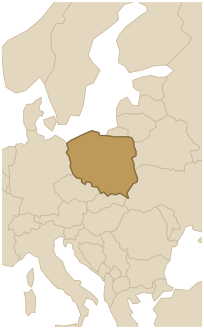
Poland lies in the centre of Europe, on a vast, open plain: its very name comes from a word for fields. This lack of natural borders has shaped its fate: with no mountains or seas to protect it, it was invaded, carved up, sometimes wiped off the map entirely over the centuries, and always put back together. About 37.5 million people live there today, around the rebuilt capital, Warsaw, and the old royal capital, Kraków, which the wars spared.
Geography
The country slopes gently northward to the Baltic Sea, with its beaches and dunes. Almost all of it is fertile plain, a patchwork of fields crossed by broad rivers such as the Vistula, which flows from the southern mountains to the sea. Only along the southern border does the land finally rise, with the Carpathians and the snowy Tatras. In the northeast survives one of Europe's last primeval forests, Białowieża, where wild bison still live.
Peoples and history
Poland was born as a nation in 966, when Duke Mieszko I converted to Christianity. In the Middle Ages and the Renaissance, joined with Lithuania, it formed one of the largest and most tolerant states in Europe, home in particular to a huge Jewish community. Then came tragedy: at the end of the 18th century its neighbours (Russia, Prussia and Austria) partitioned it and erased it for more than a century. Reborn in 1918, it was invaded in 1939, the first country attacked in the Second World War, and its soil became the main site of the Holocaust. After forty years of communism, it was in Poland, with the Solidarność trade union, that the fall of the Eastern Bloc began in 1989; the country joined NATO in 1999 and the European Union in 2004.
Language and religion
Polish is a Slavic language, a cousin of Czech and Russian, written in the Latin alphabet with many accents and consonant clusters that learners find hard. Poland is one of the most deeply Catholic countries in Europe: during the long periods of occupation, faith was the refuge of national identity. A Pole, Karol Wojtyła, became Pope John Paul II, a major figure in the fall of communism, and the country remains very proud of him.
Culture and way of life
Poland has given the world great minds: the astronomer Copernicus, who put the Sun at the centre of the system, the composer Chopin, whose mazurkas draw on the country's dances, and the physicist and chemist Marie Curie. Traditions run deep: pierogi, stuffed dumplings, borscht and sauerkraut, shared vodka, and Christmas and Easter kept with devotion.