Puerto Rico
An island of the Greater Antilles, a US territory that is deeply Latin American, home of salsa and reggaeton, born of Taíno, Spanish and African roots.
+ an immense diaspora in the United States
At a glance
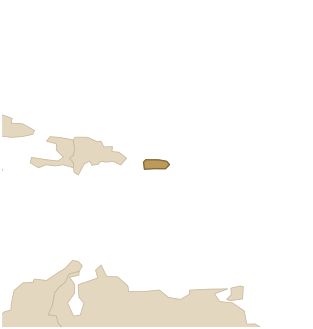
Puerto Rico is an island in the Greater Antilles, in the Caribbean Sea, deeply Latin American and yet tied to the United States: it is an unincorporated US territory whose people are American citizens, but it is neither a state nor an independent country, a status of its own and a disputed one. About 3.2 million people live there, around San Juan, while an even larger diaspora lives on the US mainland. The Puerto Rican people, Spanish-speaking and of mixed descent, grew out of the meeting of the Taíno, the Spanish and Africans. A land of salsa and reggaeton, Puerto Rico has a strong Latino identity.
Geography
Puerto Rico is a tropical island with dramatic terrain. A mountain range, the Cordillera Central, runs through its heart, covered in forest and coffee farms, while fertile coastal plains line the shore. In the northeast lies El Yunque, the only tropical rainforest in the US National Forest System, lush and full of waterfalls. The coasts alternate between beaches, mangroves and cliffs, and the nearby islands of Vieques and Culebra have some of the finest water in the Caribbean, including bioluminescent bays that glow at night. The tropical climate follows the rainy season and the hurricanes, such as Maria, which devastated the island in 2017.
History
Home to the Taíno, who called it Boriken (hence "Borinquen", the island's affectionate name), Puerto Rico was reached by Christopher Columbus in 1493 and was a Spanish colony for four centuries. The Taíno were decimated, and enslaved Africans were brought in for the sugar and coffee plantations. Out of this mixing came the Puerto Rican people. In 1898, at the end of the Spanish-American War, Spain ceded the island to the United States, and in 1917 Puerto Ricans were granted US citizenship. The question of the island's status (statehood, independence or the status quo) remains at the heart of its politics.
Language and faith
The everyday language is Spanish, spoken by everyone and central to the island's identity, alongside English, also official but less used day to day. The island is mostly Catholic, a Spanish legacy, with many patron-saint festivals, while evangelical Protestant churches have grown strongly. Folk beliefs and saints from African and Taíno traditions are mixed in.
Culture and way of life
Puerto Rican culture is Latino and Caribbean, very mixed, and it travels around the world. Above all there is music: salsa, of which San Juan is a capital, bomba and plena with drums inherited from Africa, and reggaeton, largely born here before going global. There are also the patron-saint festivals, Old San Juan with its colourful façades and blue cobblestones, art and literature. Food is a pillar of identity: mofongo (plantain mashed with garlic), arroz con gandules, roast pork (lechón) and mountain coffee.