North Korea
The northern half of the Korean peninsula, a land of mountains and rice fields, home to an ancient people who share thousands of years of history with the South.
At a glance
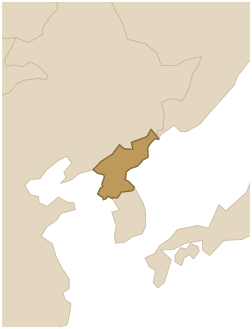
North Korea occupies the northern half of the Korean peninsula, in East Asia, between China, a short stretch of Russia and South Korea, from which it is separated by one of the most tightly closed borders in the world. About 26 million people live there; the capital is Pyongyang. Whatever the politics of one of the most isolated countries on Earth, North and South are one people, with the same language and the same long history, divided since 1945 by the upheavals of the 20th century.
Geography
North Korea is very mountainous: forested ranges cover most of the country, leaving few plains for farming, mainly in the west and along the valleys. In the north stands Mount Paektu, a snowy volcano topped by a deep blue crater lake, a sacred mountain regarded as the mythical cradle of the Korean people. The country also has coastlines on two seas and ranges such as the Kumgang mountains, the "Diamond Mountains", famous for centuries for their beauty. Winters are cold and dry.
History
The peninsula shares more than two thousand years of history: the legendary kingdom of Gojoseon, then the Three Kingdoms (including powerful Goguryeo, which ruled the north and Manchuria), followed by unification and long dynasties shared by all of Korea. The peninsula was colonised by Japan from 1910 to 1945. At the end of the war it was divided along the 38th parallel into Soviet and American zones, a division frozen by the Korean War (1950–1953), which ended without a peace treaty. In the north the Kim family took power, from Kim Il-sung to his grandson Kim Jong-un, a regime marked by a severe famine in the 1990s and by the development of nuclear weapons.
Language and culture
People speak Korean, the same language as in the South, written in Hangul, the alphabet created in the 15th century so that everyone could learn it, of which both countries are proud. Korean stands apart among the world's languages. The people share a common cultural base: the Confucian legacy of respect for family and elders, and old Buddhist and shamanic traditions, although religious practice is now tightly restricted in the North.
Way of life and traditions
Beyond the political divide, North Korea shares many traditions with the South. There is kimchi, the fermented spicy cabbage served at every meal, and a cuisine in which the north is known for its cold buckwheat noodles, naengmyeon, a Pyongyang speciality. There is also the traditional dress, the hanbok, the great festivals of the lunar calendar, folk music and dance, and a deep attachment to family and ancestors, the shared heritage of the whole Korean people.