Portugal
The Atlantic edge of Europe, the westernmost country on the mainland, which once set out from its ports to explore the world.
At a glance
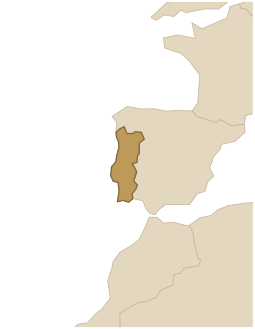
Portugal occupies the Atlantic side of the Iberian Peninsula, at the far southwest of Europe: beyond its beaches lies only the ocean. It is a fairly small country of about 10.5 million people, but its history is global, because it was from here, five centuries ago, that the navigators set out who opened up the ocean routes. Its capital, Lisbon, climbs a series of hills above a wide estuary, bathed in a light of its own.
Geography
The country is crossed from east to west by rivers flowing down from Spain to the Atlantic: the Tagus, on which Lisbon stands, and the Douro, whose terraced slopes produce port wine. The north is green, mountainous and wet; the south, the Alentejo and the Algarve, is drier and brighter, covered in cork oaks, olive trees and golden beaches. The sea is never far away, and it has shaped the country as much as the land has.
Peoples and history
Like neighbouring Spain, Portugal was first Celtic and Roman, the province of Lusitania, and then from 711 a land of Islam, al-Andalus, which left traces in its southern towns and in its language. It became an independent kingdom in 1143, and its borders are among the oldest in Europe. In the 15th century, driven by Prince Henry the Navigator, the small country took to the ocean: Vasco da Gama reached India by sea, the Portuguese Magellan led the first voyage around the world in the service of Spain, and Portugal built an empire stretching from Brazil to Africa, India and as far as Macau. Salazar's dictatorship ended in 1974 with the almost bloodless Carnation Revolution, and the country joined the European Community in 1986.
Language and religion
Portuguese, born of Latin in this land, is now, thanks to the age of discovery, one of the most widely spoken languages in the world: in Brazil, Angola, Mozambique and as far as Timor. The country is deeply Catholic by tradition: the shrine of Fátima is one of the great pilgrimage sites of the Christian world, and patron-saint festivals still set the rhythm of village life.
Culture and way of life
The Portuguese have a word of their own, saudade, a mix of longing and tenderness for what is far away or lost that is hard to translate. You hear it in fado, the melancholy song of Lisbon's alleys, on UNESCO's intangible heritage list. You see it in the azulejos, the painted tiles that cover the walls. And you taste it in food that looks to the sea: salt cod (bacalhau), said to be cooked a thousand ways, grilled sardines and pastries such as pastéis de nata.