Paraguay
The hidden heart of South America, a bilingual country where the Guaraní language is spoken by almost everyone, land of the Jesuit missions and the great Chaco.
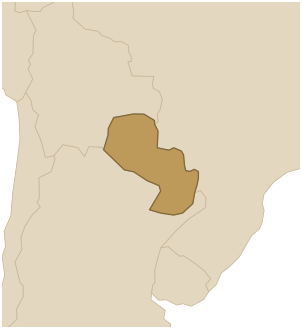
At a glance
Paraguay is a landlocked country in the heart of South America, between Argentina, Brazil and Bolivia. It has a feature rare on the continent: it is thoroughly bilingual, and the Guaraní language is spoken by almost everyone, alongside Spanish. About six million people live there; the capital, Asunción, founded in 1537, is one of the oldest cities on the continent. A land of rivers, forests and the great Chaco, Paraguay has a history both mixed and painful.
Geography
The Paraguay River splits the country into two worlds. To the east is the most populated region: green hills, forests, fertile plains and farmland along the Paraná and Paraguay rivers. To the west lies the Chaco, a vast, wild, dry and thorny plain, thinly populated, home to rich wildlife and to Indigenous and Mennonite communities. The country also shares with Brazil the colossal Itaipú dam, one of the largest in the world, which makes Paraguay a major exporter of clean electricity.
History
The land of the Guaraní saw an experiment unique in the Americas: the Jesuit missions, or "reductions", where in the 17th and 18th centuries priests and thousands of Guaraní built thriving, self-governing towns that blended Christian faith with Guaraní culture, until they were broken up. Independent from 1811, Paraguay then suffered one of the worst tragedies in South American history: the War of the Triple Alliance (against Brazil, Argentina and Uruguay), which in the 1860s killed a staggering share of its population, above all men. In the 20th century the country lived under Stroessner's long dictatorship (1954–1989) before returning to democracy.
Languages and faith
Paraguay is the only country in the Americas where a Native American language is spoken by most of the population, including people who are not Indigenous: Guaraní, official on an equal footing with Spanish, heard everywhere, at home and on the radio. The country is overwhelmingly Catholic, a legacy of the missions and colonial rule, with a popular faith mixed in places with Guaraní traditions.
Culture and way of life
Paraguayan culture is deeply mixed, born of the meeting of Spain and the Guaraní world. There is the Paraguayan harp, the national instrument, and the polkas and guaranias played all over the country. There is ñandutí lace, the "spider's web", needle-worked in radiating patterns. There is tereré, maté drunk ice-cold here against the heat and on UNESCO's intangible heritage list, chipa (a cassava and cheese bread) and sopa paraguaya.