Palestine
A land of the Near East steeped in thousands of years of history, homeland of the Palestinian people, between the hills of the West Bank and the coast of Gaza, one of the oldest centres of civilisation in the world.
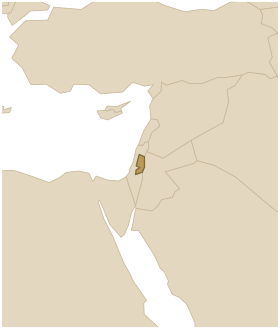
Jerusalem claimed as capital
+ a large diaspora
West Bank and Gaza
At a glance
Palestine refers to the Palestinian land and people of the Near East, in one of the oldest and most contested regions in human history. The Palestinian territory today consists of two separate parts: the West Bank, a hilly region west of the Jordan River, and the Gaza Strip, a narrow, very densely populated strip on the Mediterranean coast. Recognised as a state by a large majority of the world's countries and a UN observer state since 2012, Palestine does not have full sovereignty. About 5.5 million Palestinians live there, along with a large diaspora spread around the world.
Geography
Palestine is split between two separate territories. The West Bank is a land of limestone hills, valleys and plateaus where olive trees, vines and figs have grown for thousands of years under a Mediterranean climate. It has very old towns (Hebron, Nablus, Bethlehem, and Jericho, one of the oldest cities in the world) and, to the east, the depression of the Jordan Valley and the Dead Sea, the lowest point on land. The Gaza Strip, to the southwest, is a narrow coastal plain on the Mediterranean, one of the most densely populated places in the world.
History
This land is one of humanity's oldest homes: settled since prehistory, it saw Canaanites, Egyptians, Israelites, Persians, Greeks and Romans pass through, at the crossroads of Africa, Asia and the Mediterranean. In the 7th century the Arab conquest and the spread of Islam left a lasting mark on the population, which became mainly Arab and Muslim while keeping old Christian communities. Long an Ottoman province, Palestine came under British mandate after 1917. In 1948 the first Arab-Israeli war and the exodus of more than seven hundred thousand Palestinians (the Nakba, the "catastrophe") left a deep mark on the people's memory; in 1967 the West Bank and Gaza were occupied by Israel. Since October 2023 the war in Gaza has killed tens of thousands of people and devastated the territory, and Palestinians are still seeking a sovereign state.
Language and faith
Palestinians speak Arabic, in a Levantine dialect close to those of Syria, Lebanon and Jordan. Most Palestinians are Sunni Muslims, but there is also an old Christian community, present here since the beginnings of Christianity. This land is holy three times over: Jerusalem, Bethlehem and Hebron are among the most sacred places of Judaism, Christianity and Islam. Faith, attachment to the land and the memory of the ancestors are at the heart of an identity in which religion and national feeling are intertwined.
Culture and way of life
Palestinian culture is an Arab culture of the Levant, rooted in the land, the family and memory. There is traditional embroidery, tatreez, whose age-old patterns decorate dresses and which is on UNESCO's intangible heritage list; there is the dabke, a stamping line dance, the poetry of Mahmoud Darwish and the olive tree, a symbol of patience and attachment to the land. The food is famous across the Arab world: maqluba (upside-down rice with meat and vegetables), musakhan (chicken, onions and sumac on flatbread), hummus, olive oil and the knafeh of Nablus.