French Polynesia
A vast scattering of French islands in the heart of the Pacific, from Tahiti to the atolls, home of the great Polynesian seafarers, of lagoons and of a living Mā'ohi culture.
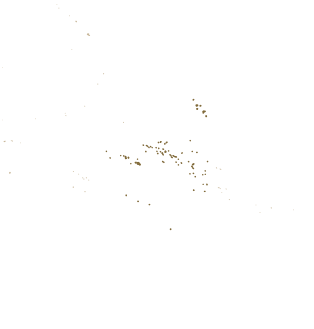
of land, scattered over a space the size of Europe
At a glance
French Polynesia is a vast group of French islands scattered across the heart of the South Pacific, an overseas collectivity with wide self-government. Its 118 islands, spread over five archipelagos (including the Society Islands, with Tahiti and Bora Bora, the Marquesas and the Tuamotus), add up to little land but stretch over an area of ocean the size of Europe. About 280,000 people live there, most of them on Tahiti, around Papeete. The Polynesian Mā'ohi people descend from the seafarers who settled the largest ocean in the world.
Geography
French Polynesia has two kinds of island scattered over the vast Pacific. The high, volcanic islands, such as Tahiti, Moorea and the Marquesas, raise jagged peaks, lush valleys and waterfalls above turquoise lagoons ringed by reefs. The atolls of the Tuamotus are just thin rings of coral and coconut palms around huge lagoons, barely above the ocean. The sea is everywhere: clear water, coral gardens, rays and sharks, coconut groves and tiare flowers. The climate is tropical, hot and humid.
History
These islands were settled, at the end of one of humanity's greatest sea voyages, by Polynesian seafarers from Southeast Asia and the western Pacific, who in large double-hulled canoes guided by the stars colonised islands thousands of kilometres apart. Europeans arrived in the 18th century, and Tahiti became the myth of the South Seas "paradise". A Tahitian kingdom took shape; the island became a protectorate and was annexed by France in 1880. Between 1966 and 1996 France carried out 193 nuclear tests at Moruroa and Fangataufa. Now a largely self-governing collectivity, French Polynesia asserts its Mā'ohi identity within the Republic.
Language and faith
In French Polynesia, French is the official language, but Tahitian (reo mā'ohi) and the other Polynesian languages of the archipelagos are very much alive and enjoying a revival. Most people are Christian, since the missionary work of the 19th century: Protestant (the Mā'ohi Protestant Church is very present) and Catholic, and religion plays a large part in social life, with its church choirs, the himene. This faith blends with respect for sacred places and ancient traditions, mana and tapu, the spiritual heritage of the Polynesian world.
Culture and way of life
Polynesian culture is that of the Mā'ohi, turned towards the sea, dance and nature. There is 'ori tahiti, a dance of swaying hips, celebrated at the great Heiva festival; there is Polynesian tattooing (the tatau, which gave English the word "tattoo"), with its sacred patterns, the art of the Marquesas, flower crowns and garlands, the 'ukulele and singing. Life revolves around the lagoon, fishing and celebration. People eat raw fish in coconut milk, the national dish, food cooked in the ahima'a (a Polynesian earth oven) and breadfruit, and they grow Tahitian vanilla.