Réunion
A French volcanic island in the Indian Ocean, a land of cirques and peaks, settled from every shore of the ocean.
At a glance
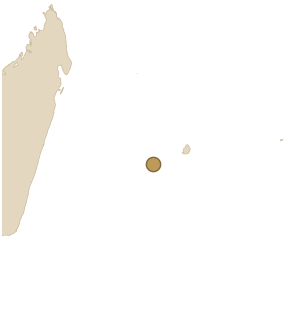
Réunion is a French island in the Indian Ocean, east of Madagascar; as an overseas department and region, it is fully part of France and of the European Union, nearly ten thousand kilometres from Paris. About 885,000 people live there; the main town is Saint-Denis. It is one of the most mixed societies in the world: uninhabited before Europeans arrived in the 17th century, the island was settled by French colonists, enslaved Africans and Malagasy, and later Indian and Chinese workers, whose descendants now form a Creole people.
Geography
Réunion is a young volcanic island that rose from the sea as a mountain. At its heart, three cirques (Mafate, Cilaos and Salazie), huge amphitheatres of cliffs and ravines, surround the Piton des Neiges, the highest point in the Indian Ocean. To the southeast rumbles the Piton de la Fournaise, one of the most active volcanoes in the world, whose lava regularly reaches the sea. The island's misty "Pitons, cirques and remparts", covered in forests and waterfalls, are a World Heritage site. The tropical climate, cooled by altitude, creates a great range of landscapes, from the moonlike volcano to forests full of orchids.
History
Until the 17th century the island was uninhabited: all Réunionese descend, in varying degrees, from people who came from elsewhere. France took possession of it and settled it from 1665, under the name Île Bourbon. The plantation economy, first coffee and then sugar, depended on slavery: Africans from the east coast and Malagasy were shipped there in large numbers. After abolition in 1848, indentured workers were brought in from India, many of them Tamils, and from China. Out of this mixing came Réunion's Creole society. In 1946 the island became a full French department.
Language and faith
People speak French, the official language, and above all Réunion Creole, a language born of the island's mixing, French-based but enriched by Malagasy, Tamil and African languages, central to the island's identity and spoken by almost everyone. Several religions live side by side: Catholicism, the majority faith, alongside the Hinduism of the Tamils with its colourful temples, the Islam of the "Zarabes" (Muslims from India), Buddhism and Chinese traditions. It is not unusual for one family to honour several traditions.
Culture and way of life
Réunion's culture is Creole, born of the meeting of Africa, Madagascar, Europe, India and China. There is maloya, music and dance inherited from the enslaved, long frowned upon and now on UNESCO's intangible heritage list, and the lighter séga; there are the festivals of every community: Tamil Dipavali, Chinese New Year and the Catholic feasts. The food is mixed: cari (meat or fish stewed with spices) served with rice, beans and rougail, rougail saucisses, samosas and rhum arrangé, rum steeped with fruit and spices.