Romania
A Latin-speaking island in the Slavic world, land of the Carpathians and Transylvania, of vampire legends and of villages that time has left alone.
At a glance
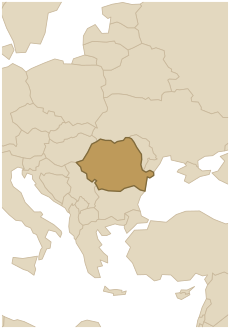
Romania lies in southeastern Europe, where the Balkans meet Central Europe, between the Carpathians and the Black Sea. It is an island of Latin speech surrounded by Slavic and Hungarian peoples. Romanians trace their roots to ancient Rome, and their language, a cousin of French and Italian, bears the mark of it down to its very name. About 19 million people live there; the capital, Bucharest, was once nicknamed the "little Paris" of the East.
Geography
The country is built around the arc of the Carpathians, forested mountains that sweep through it in a great crescent around the high plateau of Transylvania. Around them lie rich farming plains watered by the Danube, which forms the southern border before reaching the Black Sea in a vast, wild delta, home to countless birds and a World Heritage site. The mountains still hold large old-growth forests, among the last in Europe, where bears, wolves and lynx live.
Peoples and history
Before Rome, the Dacians lived here. Their conquest by the emperor Trajan in the 2nd century, and the Roman settlement that followed, gave rise to the Romanian language. In the Middle Ages the principalities of Wallachia and Moldavia took shape, long caught between the Ottoman, Austrian and Russian empires. From this period comes the country's most famous figure: Vlad the Impaler, a prince of Wallachia born in Transylvania, whose nickname inspired Bram Stoker's Dracula. The principalities united in 1859, and Transylvania joined Romania in 1918. After Ceaușescu's communist dictatorship was overthrown in 1989, the country joined NATO in 2004 and the European Union in 2007.
Language and religion
Romanian is the only major Latin language of Eastern Europe: born of the Latin of Roman settlers, it is still recognisable to anyone who speaks French or Italian, though it has taken in many Slavic words. The country is overwhelmingly Orthodox Christian by tradition, with its monasteries, including those of Bucovina with frescoes painted on their outer walls. Transylvania also keeps Catholic and Protestant communities, Hungarian and German, from its past.
Culture and way of life
Romania is rich in folk traditions that are still very much alive, especially in the countryside: embroidered costumes, dances, songs and festivals mark the year. It has given the world great artists, such as the sculptor Brâncuși, a pioneer of modern art, and the composer George Enescu. Transylvania, with its castles and fortified Saxon villages, draws lovers of legend. At the table there are sarmale (stuffed cabbage leaves) and maize mămăligă, and toasts are made with țuică, plum brandy.