Russia
The largest country on Earth, stretching from Europe to the Pacific across eleven time zones, between the West and the vastness of Asia.
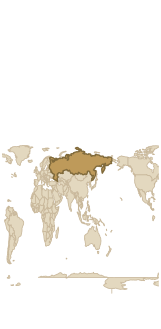
the largest country in the world
+ more than 100 languages
At a glance
Russia is by far the largest country on the planet: it covers more than a ninth of the world's land and stretches from Europe to the Pacific, across the whole of northern Asia, over eleven time zones. It is a country split between Europe, where its culture comes from, and the Asian vastness of Siberia. Some 144 million people live there, most of them in the European part in the west, around the capital, Moscow.
Geography
Russia's land unrolls in vast horizontal belts. In the south is the steppe, endless grassland from which horsemen once swept out. In the centre and north lies the taiga, the largest forest in the world, and then the frozen tundra along the Arctic Ocean. In the east, Siberia holds Lake Baikal, the deepest and oldest lake on Earth. Great rivers such as the Volga, and the Ural mountains, which divide Europe from Asia, give shape to a territory the size of a continent. The long, harsh winter has shaped the country as much as its history has.
Peoples and history
Russia traces its origins to Kievan Rus', the first great state of the Eastern Slavs, which Ukraine and Belarus also claim as their heritage, and which adopted Byzantine Orthodox Christianity in 988. Subjugated by the Mongols for two centuries, Russia rose again around Moscow, whose princes took the title of tsar and pushed east all the way to the Pacific. Peter the Great opened the country to Europe and built Saint Petersburg; Catherine II expanded the empire. In 1917 the revolution overthrew the tsars and gave birth to the Soviet Union, one of the century's two superpowers, which collapsed in 1991. Since 2022 Russia has been waging a war of invasion against Ukraine.
Language and religion
Russian is a Slavic language, the most widely spoken in its family, written in the Cyrillic alphabet, created in the Orthodox Slavic world on the model of the Greek alphabet. It is one of the great languages of world literature. The main religion is Orthodox Christianity, with its onion-domed churches, icons and chants, long repressed under the Soviet regime before returning to prominence. Among its hundred or so nationalities, the country also has large Muslim and Buddhist populations.
Culture and way of life
Few countries have contributed so much to art and thought. Russian literature (Tolstoy, Dostoevsky, Chekhov) probed the human condition; Tchaikovsky's music and the Bolshoi Ballet are known throughout the world. Daily life has its own rituals: tea from the samovar, borscht and blini, shared vodka, the banya, a scalding steam bath followed by a roll in the snow, and the nesting dolls, matryoshkas.