Saudi Arabia
The heart of the Arabian peninsula, cradle of the Arabic language and of Islam, a land of deserts and Bedouin that became an oil power within a century.
At a glance
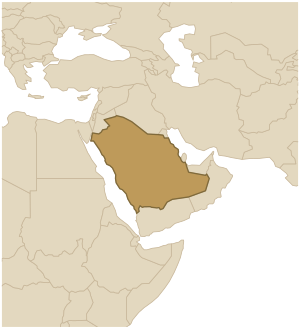
Saudi Arabia occupies most of the Arabian peninsula, a vast block of desert between the Red Sea and the Persian Gulf. It is a huge and almost entirely arid country, where some 35 million people live mainly in large modern cities such as the capital, Riyadh. Arabia holds a special place: Islam was born in Mecca and Medina, and nearly two billion believers turn towards Mecca every day to pray. It is also the birthplace of the Arabic language.
Geography
The country is a kingdom of deserts. In the south lies the Rub' al-Khali, the "Empty Quarter", the largest continuous expanse of sand on Earth, almost uninhabited. In the west, along the Red Sea, runs a mountain range, the Hejaz, home to the holy cities; in the centre is the Nejd plateau, the historic heart of the country; in the east, along the Gulf, lie the oil fields that changed everything. Water is so scarce that life was long organised around oases and wells.
History
Long before Islam, Arabia was crossed by caravans carrying incense and spices, and home to nomadic Bedouin tribes and trading towns such as Mecca. Everything changed in the 7th century: the prophet Muhammad, born in Mecca, preached Islam there, and from the peninsula, within a few decades, came one of the fastest expansions in history, carrying the new faith and the Arabic language from Spain to India. The peninsula then became a backwater again, until in the 20th century the house of Saud unified the kingdom (1932), soon transformed by the discovery of vast oil reserves. Since the late 2010s, Crown Prince Mohammed bin Salman has pushed through sweeping economic and social reforms while tightening repression.
Language and faith
Arabic was born in this peninsula, where it found its classical form, that of the Quran: a language of poetry before it was a language of faith, cultivated by the ancient Bedouin in long poems recited in their tents. Arabia is the heart of Islam: the king bears the title "Custodian of the Two Holy Mosques", and every year the great pilgrimage, the hajj, brings millions of believers from all over the world to Mecca, one of the largest human gatherings on the planet.
Culture and way of life
Beneath the modern skyscrapers, Saudi culture is still shaped by its Bedouin desert heritage: a sense of honour and tribe, poetry recited aloud and above all hospitality. Guests are welcomed with dates and qahwa, a light coffee spiced with cardamom poured as a gesture of welcome. Falconry, camel racing and great meals of rice and lamb, kabsa, recall the world of the nomadic ancestors.