Sudan
The land of ancient Nubia, where the two branches of the Nile meet, a kingdom of pyramids and "Black pharaohs" at the crossroads of the Arab world and Africa.
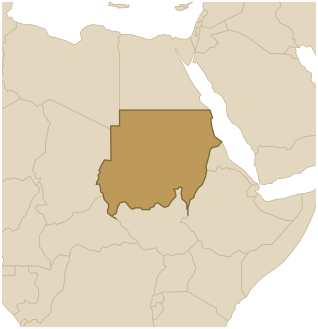
3rd largest in Africa
+ many languages
At a glance
Sudan is a vast country in northeastern Africa, one of the largest on the continent, where the Arab world meets sub-Saharan Africa, a position that is both its wealth and the source of its tensions. It is crossed and defined by the Nile: at Khartoum, the capital, the White Nile from the Great Lakes and the Blue Nile from Ethiopia join to form the great river that flows on to Egypt. About 50 million people live there, many of them along this ribbon of life running through the desert.
Geography
The north of the country lies in the Sahara desert and its fringes, land of sand and stone made habitable only by the Nile. Further south, the desert gives way to the Sahel, then to greener savanna and marshland. The Nile and its tributaries are the axis of everything, lined with palm groves and fields farmed for thousands of years. To the east the country reaches the Red Sea; to the west lie the highlands of Darfur.
History
This land holds one of Africa's oldest civilisations, that of Nubia and the kingdom of Kush, long a rival and neighbour of pharaonic Egypt. In the 8th century BCE the kings of Kush conquered Egypt and ruled it: these were the "Black pharaohs". Around their capital, Meroë, they built hundreds of pyramids, more than Egypt's but far less known. After the Christian kingdoms of Nubia, Islam and Arabic spread through the north. Under Anglo-Egyptian rule, Sudan became independent in 1956; South Sudan broke away in 2011. Since 2023 a war between the army and the paramilitary Rapid Support Forces has caused one of the worst humanitarian crises in the world.
Peoples, language and faith
Sudan has many peoples: Arabic-speaking Muslim populations dominate the north and centre, while Nubian peoples and many other groups with their own languages live there too, especially in Darfur and the south. Arabic is the main shared language, alongside English and dozens of local languages. The country is overwhelmingly Sunni Muslim, with a strong Sufi tradition whose ceremonies of chanting and dancing around saints' tombs are famous.
Culture and way of life
Sudanese culture blends Arab, Nubian and African heritage. Poetry and music matter a great deal, from Sufi chants to modern songs. Guests are welcomed with spiced coffee, slowly brewed in a clay pot, the jebena. And there are the remains of a great past: the pyramids of Meroë, standing in the sand, from a time when this land was one of the great powers of the ancient world.